
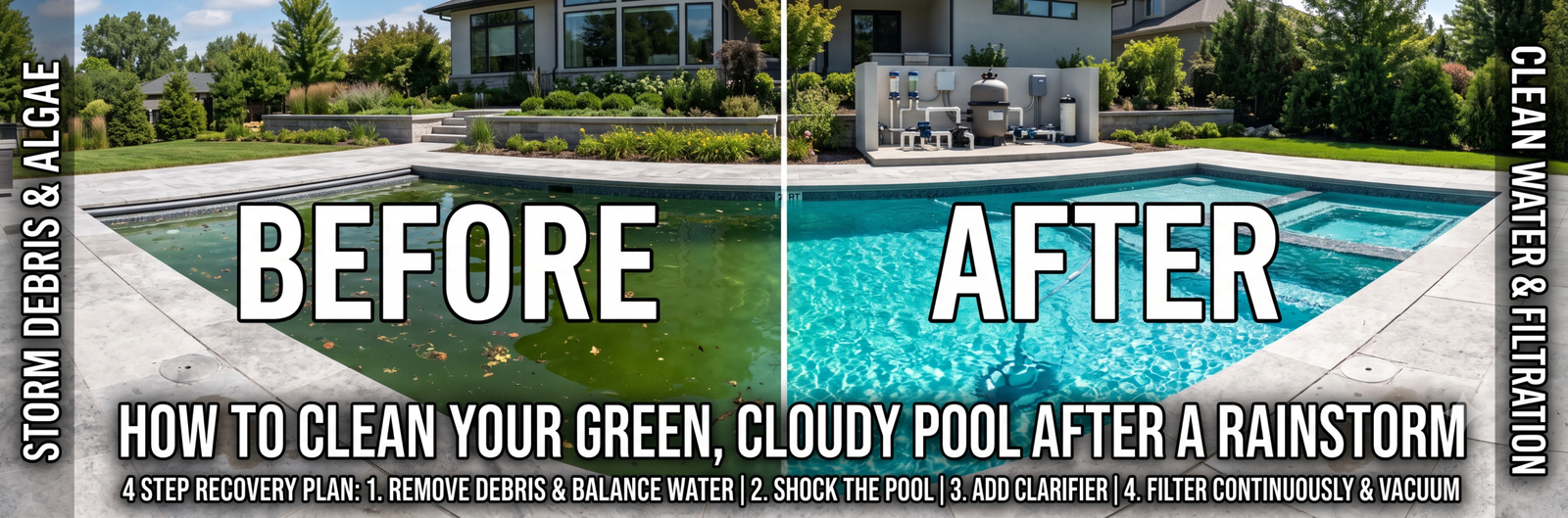
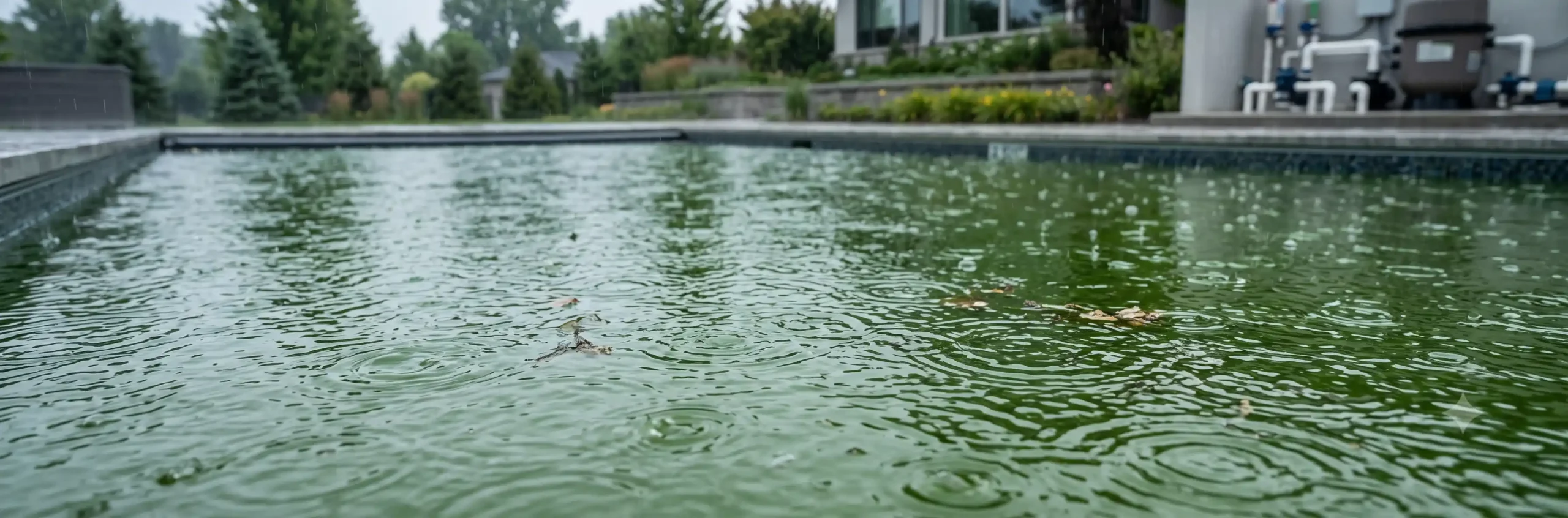
How to clean your green, cloudy pool after a rainstorm is a challenge every pool owner faces eventually. There is nothing quite like walking out to your backyard on a warm weekend morning, expecting a refreshing swim, only to discover that your once-sparkling swimming pool has transformed into a murky, green swamp overnight. Heavy summer storms and severe downpours do much more than simply fill your pool with extra water. They wash in massive amounts of organic debris, dust, pollen, nitrogen, and airborne algae spores while instantly stripping away your free chlorine. When high outdoor temperatures meet a sudden influx of unchlorinated, nutrient-rich rainwater, algae takes over with astonishing speed, leaving behind a cloudy green mess. If you want to master how to clean your green, cloudy pool after a rainstorm, you are not alone, as thousands of homeowners face this exact post-storm headache every single season.
Tackling a post-storm algae bloom can feel overwhelming, but you do not need to panic or drain your pool vessel. Restoring your water requires a methodical, step-by-step approach rather than random guesswork. If you are looking for a reliable, comprehensive guide on how to clean your green, cloudy pool after a rainstorm, you are in the exact right place. In this detailed guide, we will walk you through the complete recovery process—from clearing out physical debris and balancing your water chemistry to superchlorination and continuous filtration—while showing how partnering with Aquastar can make ongoing pool upkeep completely effortless.
To fix a green pool successfully, it helps to understand the exact science of what happens beneath the surface during and after severe weather. Rainwater is naturally acidic and acts like an atmospheric vacuum cleaner as it falls through the sky, collecting nitrogen, dust, pollen, and microscopic organic particles along the way. When thousands of gallons of this runoff mix directly with your pool water, several major chemical and biological shifts occur simultaneously:
The Severe Sanitizer Crash: The sheer volume of incoming rainwater dilutes your existing free chlorine and stabilizer concentrations, leaving the water completely unprotected against opportunistic bacteria and spores.
pH and Alkalinity Disruption: Acidic rainfall pulls your pool’s pH and total alkalinity buffers down rapidly, creating a corrosive environment that drastically reduces chlorine effectiveness.
The Organic Nutrient Feast: Storm winds sweep lawn fertilizers, soil runoff, decaying leaves, and insects straight into the water, providing a rich buffet of nitrates and phosphates that algae feeds on to multiply exponentially.
Rapid Spore Proliferation: Airborne algae spores carried by storm winds thrive in warm, unchlorinated water, reproducing so quickly that they turn a crystal-clear pool opaque green in less than twenty-four hours.
Because of these factors, knowing how to clean your green, cloudy pool after a rainstorm requires addressing both the physical organic waste and the underlying chemical imbalance at the same time. Without understanding this dynamic, homeowners often waste days applying temporary chemical fixes that fail to solve the root cause. Whenever you learn how to clean your green, cloudy pool after a rainstorm, you realize that chemistry and filtration must work in absolute harmony.
Fixing a swampy pool takes patience, discipline, and the right sequence of actions. If you rush the chemical application or skip the physical cleaning steps, you will end up wasting time and expensive chemicals on treatments that simply get trapped in organic sludge. Follow this proven 7-phase recovery sequence to bring your water back to pristine condition.
| Recovery Phase | Primary Goal | Practical Action to Take |
|---|---|---|
| Phase 1: Physical Cleanup | Remove food sources for algae | Skim floating leaves, brush walls, and vacuum settled silt directly to waste. |
| Phase 2: Water Level Reset | Fix dilution and high water lines | Use the multi-port valve Waste setting to bring water back to the skimmer midpoint. |
| Phase 3: Chemistry Balance | Prepare water for effective shocking | Test and adjust Total Alkalinity (80–120 ppm) and pH (7.2–7.6). |
| Phase 4: Shock Treatment | Kill active bacteria and algae | Superchlorinate with high-strength calcium hypochlorite to 10+ ppm at sunset. |
| Phase 5: Clarification & Floc | Drop suspended dead particles | Apply a polymer clarifier or flocculant to clump micro-debris. |
| Phase 6: Relentless Filtration | Clear out dead organic matter | Run filter pump 24/7, backwashing or cleaning cartridges when pressure rises. |
| Phase 7: Final Polish | Restore balance for swimming | Re-test chemistry, stabilize cyanuric acid, and resume normal operating schedules. |
When you master how to clean your green, cloudy pool after a rainstorm, you protect your pool equipment from premature strain and ensure your swimming environment remains safe for family and guests. Furthermore, understanding how to clean your green, cloudy pool after a rainstorm gives you the confidence to handle unpredictable summer weather without missing a beat.
Algae thrives by feeding on decaying organic matter. Before you touch a single chemical bottle, you must physically remove the leaves, twigs, and organic sludge resting at the bottom and floating on top of the water.
Scoop out floating leaves and twigs using a wide leaf net. Next, grab a stiff pool brush and vigorously scrub your walls, steps, and tile lines. This breaks up the slimy biofilm protecting the algae spores, exposing them so chemical treatments can destroy them effectively. Finally, vacuum the pool floor thoroughly. If your pool is deeply green and swampy, switch your multi-port valve to the Waste position so the heavy, filthy water discharges out of your yard entirely, rather than clogging your filter media and returning dirty water to the pool. When evaluating how to clean your green, cloudy pool after a rainstorm, skipping this manual physical cleaning step is the most common reason amateur recovery efforts fail.
Severe storms often leave water spilling over the coping stones or sitting too high inside the skimmer hatch, which prevents proper surface skimming.
Adjust your filter system’s multi-port valve to Waste or Drain and pump out excess water until the level rests right at the exact midpoint of your skimmer box. This ensures optimal surface skimming once your filtration pump begins running continuously during the treatment process. When determining how to clean your green, cloudy pool after a rainstorm, proper water level adjustment is essential for filtration efficiency.
Never skip this critical chemical preparation step. If your water’s pH is unbalanced, your chlorine shock will lose up to 50% of its germ-killing strength, rendering your treatment far less effective.
Test your water using a reliable test kit and adjust your Total Alkalinity first using sodium bicarbonate so it lands between 80 and 120 parts per million. Once alkalinity is steady, adjust your pH level into the ideal 7.2 to 7.6 comfort zone using soda ash (if it is too low) or muriatic acid (if it is too high). Proper chemical balancing is an irreplaceable pillar of how to clean your green, cloudy pool after a rainstorm successfully.
To wipe out a heavy algae bloom after severe weather, standard daily chlorine levels will not cut it. You need to superchlorinate the water, driving your free chlorine level up to 10 parts per million or higher.
Calculate your pool’s gallon capacity and add a potent shock treatment, such as calcium hypochlorite or liquid chlorine, directly over the deep end while the pump is running. Always perform this step in the evening after direct sunlight has faded, as ultraviolet rays destroy fresh chlorine rapidly. Let your pump run continuously overnight to mix the solution thoroughly through every corner of the pool vessel. This shocking process is the core mechanism of how to clean your green, cloudy pool after a rainstorm effectively.
The morning after a successful shock treatment, your vibrant green pool will typically transform into a dull, milky gray or cloudy blue haze. This haze consists of millions of dead algae cells and oxidized organic waste suspended in the water column.
To speed up the clearing process, add a polymer-based water clarifier to help your filter trap micro-particles. Alternatively, if your pool floor is blanketed in a thick layer of dead gray silt, use a pool flocculant. Flocculant forces all suspended debris to drop to the floor overnight into a heavy blanket that you can carefully vacuum straight to Waste the next morning. Utilizing clarifiers is another vital trick in how to clean your green, cloudy pool after a rainstorm.
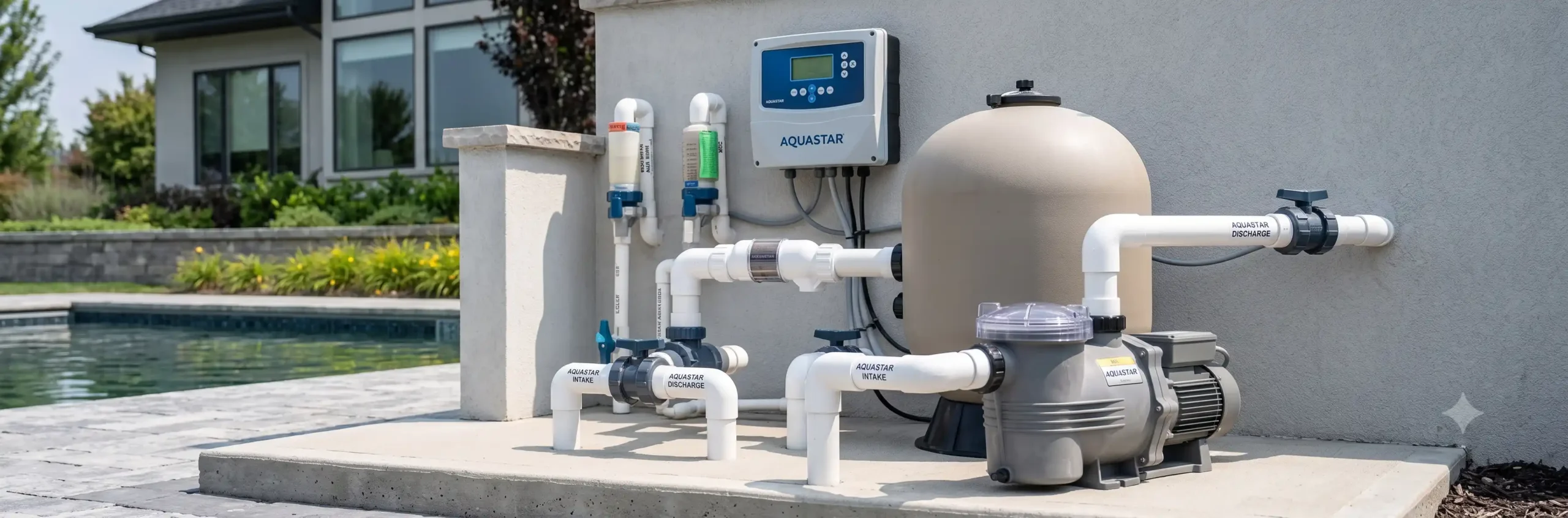
Clearing cloudy water requires non-stop filtration. Turn your filter pump on and let it run 24 hours a day without interruption until you can clearly see the bottom drain at the deep end.
Because your filter will be capturing massive loads of dead algae and fine silt, pressure levels will climb quickly. Keep a close eye on your pressure gauge, and backwash sand filters or rinse cartridge elements whenever operating pressure rises 8 to 10 PSI above your clean baseline. Continuous filtration is mandatory when learning how to clean your green, cloudy pool after a rainstorm.
Once crystal-clear water returns, run a complete chemical test to ensure everything is safe for swimmers.
Allow your free chlorine levels to drop back down to a safe swimming range of 2.0 to 4.0 parts per million. Check your cyanuric acid (stabilizer) levels and add stabilizer if rain dilution dropped it below 30 ppm. Once every metric checks out, your pool is officially ready for swimmers again, and you can return to your normal 8-hour daily pump cycle, completing your journey on how to clean your green, cloudy pool after a rainstorm.
Battling severe post-storm algae blooms, hauling heavy chemical bags, and spending entire weekends vacuuming can quickly take the joy out of pool ownership. This is where Aqvastar steps in to transform your maintenance routine into a completely hands-off, worry-free experience.
Aqvastar provides comprehensive, premium swimming pool solutions—ranging from advanced automated filtration equipment to expert on-site maintenance services:
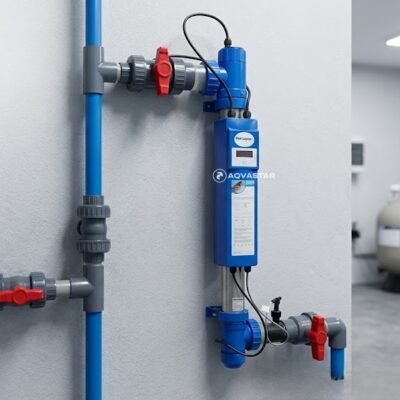
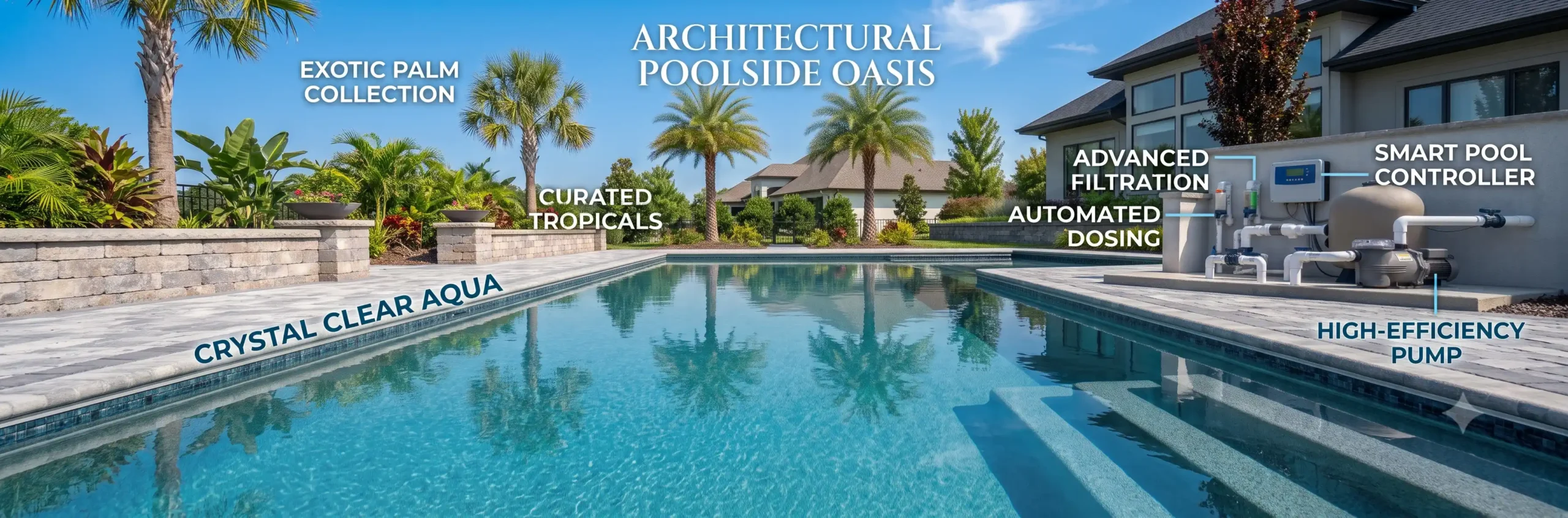
Instead of manually measuring and dumping heavy chlorine shock after every major rainstorm, Aqvastar offers state-of-the-art automatic salt chlorinators and smart chemical dosing units. These automated systems monitor water conditions in real time and generate pure active chlorine on demand, keeping your pool sanitized automatically and preventing algae before it ever starts. With Aqvastar automated systems, figuring out how to clean your green, cloudy pool after a rainstorm becomes a thing of the past because preventive sanitation happens automatically.
Aqvastar equips pools with high-performance sand filters, cartridge filters, and energy-efficient variable-speed pumps. Engineered to manage heavy organic loads and severe post-storm debris, Aqvastar’s filtration technology captures ultra-fine silt quickly, ensuring your water clears up in record time when you practice how to clean your green, cloudy pool after a rainstorm.
If your pool is severely compromised and you prefer expert assistance, Aqvastar’s team of certified pool technicians provides specialized green-to-clean recovery services. From heavy debris vacuuming and chemical shock treatments to complete equipment diagnostics, Aqvastar ensures your pool stays pristine, hygienic, and inviting all year round.
Learning how to clean your green, cloudy pool after a rainstorm comes down to following a disciplined recovery process: removing organic debris, balancing your water chemistry, superchlorinating to kill active algae, and running your filtration system continuously until the water shines. By taking swift action after severe weather, you protect your pool investment and restore a safe swimming environment for your family and guests. Once you master how to clean your green, cloudy pool after a rainstorm, seasonal downpours will never catch you off guard again.
With Aqvastar as your trusted pool partner, managing post-storm recovery and daily maintenance is completely hassle-free. From automated salt chlorinators and high-efficiency filtration to expert professional care, Aqvastar delivers reliable, crystal-clear results every single season.