The monsoon season brings a welcome break from scorching summer temperatures, but for pool owners, it brings a fresh set of operational challenges. Heavy downpours, high humidity, and atmospheric pollutants can quickly transform a sparkling pool into a cloudy, green headache overnight. Rainwater dilutes essential sanitizers, alters water chemistry, and introduces organic debris, creating ideal conditions for algae blooms and bacterial growth.
If you are wondering how to care for swimming pool in monsoon weather without spending hours on exhausting manual labor, you are in the right place. Proper rain-season maintenance goes beyond skimming floating leaves—it requires a proactive strategy encompassing water drainage, balanced chemistry, structural protection, and efficient filtration.
In this comprehensive guide, we break down the essential maintenance steps to keep your pool crystal clear all season long, while explaining how partnering with Aquastar can automate and simplify your pool care routine.
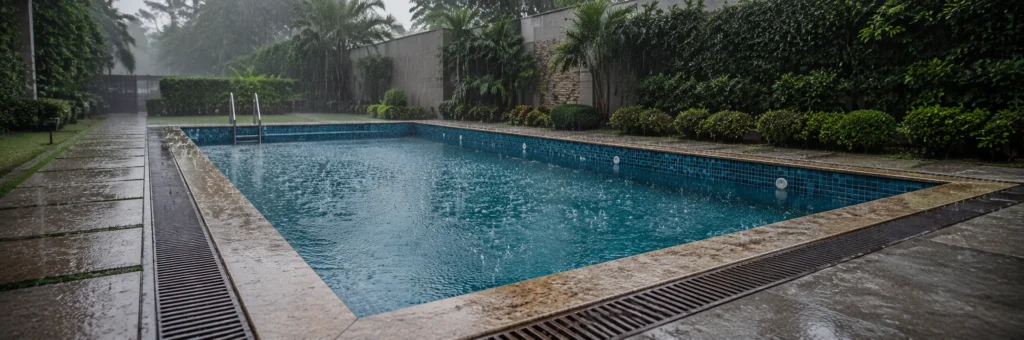
Understanding the direct impact of rainwater on pool water quality is the first step toward effective seasonal maintenance. Rainwater is naturally acidic and absorbs atmospheric dust, nitrogen, pollen, and fungal spores as it falls. When hundreds or thousands of gallons of rainwater mix with your pool water, several immediate shifts occur:
Chemical Dilution: The sheer volume of incoming rainfall lowers free chlorine levels, stabilizer concentrations, and overall salinity.
pH Drop: Acidic rainfall disrupts your pool’s natural pH and total alkalinity buffers, causing water to become corrosive.
Organic Overload: Storm winds wash garden runoff, dirt, dead leaves, and insects directly into the pool vessel.
Algae Growth: Airborne algae spores introduced by monsoon winds thrive in warm, low-chlorine environments, turning water cloudy or green within hours.
Managing a swimming pool during heavy rainfall does not have to be overwhelming if you follow a structured maintenance checklist.
| Maintenance Area | Typical Monsoon Problem | Immediate Action Required |
|---|---|---|
| Water Level | Excessive accumulation, overflow risk | Run multi-port valve on Waste or Drain setting |
| Water Chemistry | Free chlorine drops, pH shifts acidic | Double shock pool; add pH increaser (Soda Ash) |
| Filtration System | Clogged baskets, high filter pressure | Backwash sand filter; run pump 12–16 hours/day |
| Algae Prevention | Green water, slippery plaster surfaces | Apply weekly preventive dose of non-foaming algaecide |
| Physical Shell | External groundwater pressure risk | Maintain internal water weight; check relief valves |
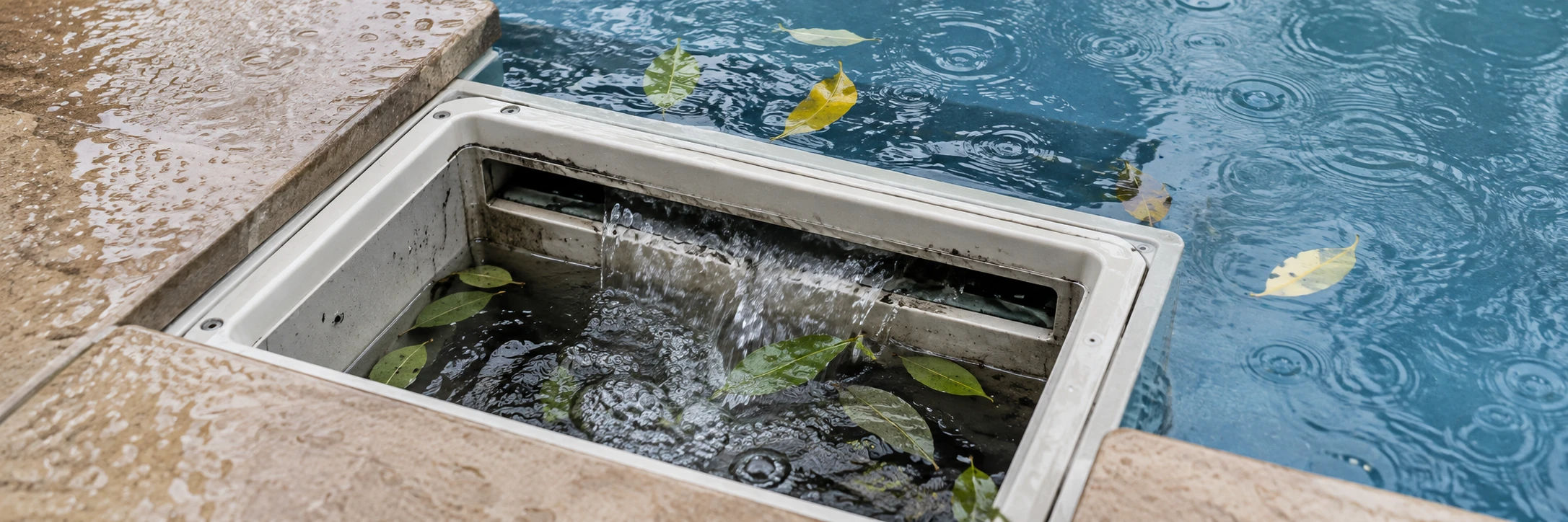
Heavy downpours cause pool water levels to rise rapidly. When water levels exceed the midpoint of your skimmer hatch, the skimmer loses its skimming action and cannot draw floating debris off the surface. If water overflows over the coping stone, ground soil and dirty garden runoff wash directly into your pool.
Check water levels daily during active storm cycles. Use your filter’s multi-port valve on the Waste or Drain setting to lower the water level back to the middle of the skimmer box. Never let water sit higher than three-quarters of the way up the skimmer mouth.
Rainwater acts as a constant dilutant. Testing your water twice a week during the monsoon is critical to maintain essential sanitation parameters.
| Water Parameter | Ideal Target Range | Monsoon Impact & Action Step |
|---|---|---|
| Free Chlorine | 2.0 – 4.0 ppm | Drops rapidly due to organic load. Maintain near 4.0 ppm. |
| pH Level | 7.2 – 7.6 | Drops due to acidic rain. Add Soda Ash when pH falls below 7.2. |
| Total Alkalinity | 80 – 120 ppm | Buffers pH swings. Add Sodium Bicarbonate if below 80 ppm. |
| Cyanuric Acid (CYA) | 30 – 50 ppm | Dilutes over time. Replenish stabilizer after heavy rain cycles. |
Do not wait for your water to turn cloudy or green before taking action. Superchlorinating (shocking) your pool before and immediately after heavy storms raises free chlorine levels to 10 ppm, destroying organic contaminants before algae can take root.
In addition to shocking, apply a weekly preventive dose of a high-purity, non-foaming polyquat algaecide. This provides a reliable backup shield against stubborn green, yellow, and black algae strains.
During monsoon months, your filtration system works twice as hard to clear suspended silt and fine debris. Increase your daily filtration cycle from the standard 8 hours to 12–16 hours per day. During multi-day storm events, consider running your pump continuously.
Keep a close eye on your filter pressure gauge. Clean cartridge filters or backwash sand filters whenever operating pressure rises 8 to 10 PSI above clean baseline pressure to prevent pump strain.
Monsoon rainfall saturates the ground around your pool, causing groundwater levels to rise significantly. This groundwater exerts upward force, known as hydrostatic pressure, against the outside of your pool shell.
If a pool is partially or fully drained during the monsoon season, this external groundwater pressure can cause concrete shells to crack or fiberglass pools to shift out of the ground.
Maintain Internal Water Weight: Never drain your pool below normal operating levels during monsoon months. The weight of the water inside acts as a counterweight against external soil pressure.
Inspect Relief Valves: If your pool is equipped with a hydrostatic relief valve at the main drain, ensure it remains free of debris so groundwater can safely equalize if necessary.
Heavy rain and outdoor electrical equipment require careful monitoring to prevent short circuits and component damage.
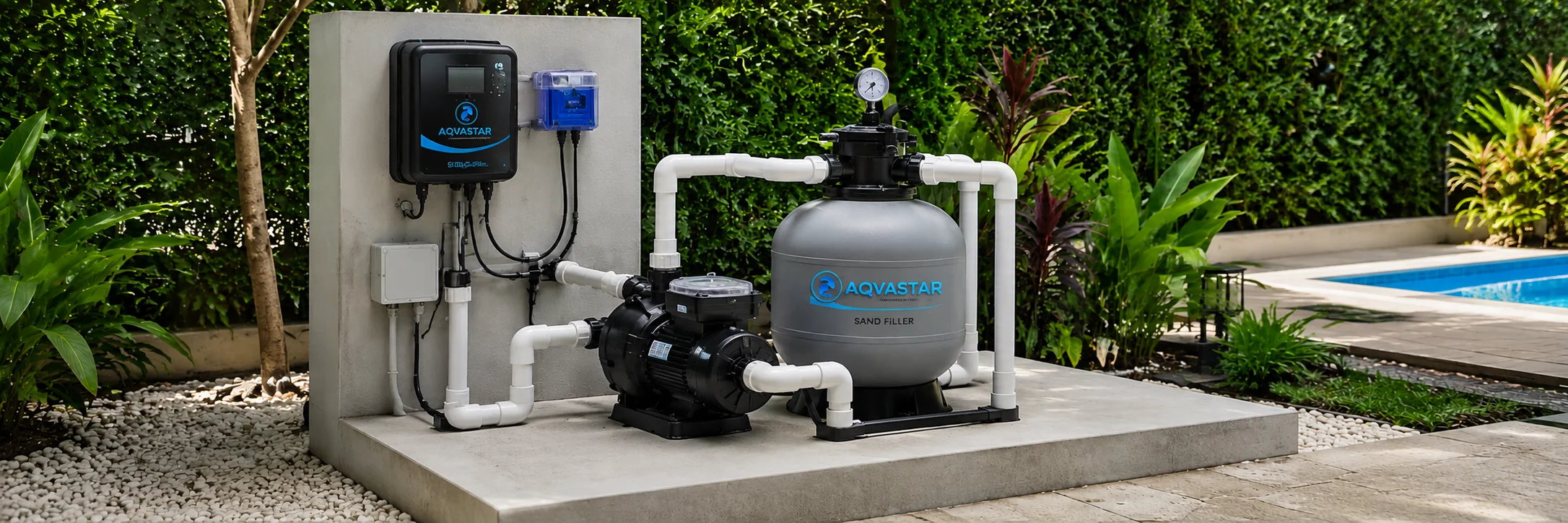
Elevate Circulation Equipment: Ensure your filtration pump sits elevated on a concrete slab rather than directly on soil, preventing standing rainwater from surrounding the motor housing.
Inspect Control Enclosures: Verify that all outdoor automation panels and timer boxes have intact weatherproof seals to prevent moisture intrusion.
Check Grounding and Outlets: Test all Ground Fault Circuit Interrupter (GFCI) outlets monthly to ensure complete electrical safety around wet pool decks.
Once the rainy season concludes, transition your pool back to its standard operational schedule:
Deep Clean Filter Media: Perform an extended backwash cycle on sand filters or soak cartridge elements in a specialized cleaning solution to remove accumulated oils and organic silt.
Rebalance Key Chemistry: Bring Total Alkalinity back to 80–120 ppm, adjust pH to 7.2–7.6, and replenish Cyanuric Acid to 30–50 ppm.
Normalize Pump Cycles: Return your pump run times to standard 8-hour daily operational schedules and adjust sanitization output accordingly.
Managing water balance, clearing heavy debris, and sourcing high-grade chemicals throughout the rainy season can become a demanding chore. This is where Aqvastar makes pool ownership completely stress-free.
Aquastar provides complete end-to-end swimming pool solutions—from advanced automated equipment to professional pool care services. Here is how Aqvastar supports your pool during the monsoon season and beyond:
Instead of manually testing water and adding chemical chlorine after every rainstorm, Aquastar offers state-of-the-art automatic salt chlorinators and smart dosing systems. These automated units monitor sanitizer levels continuously and generate pure active chlorine on demand, keeping your pool sanitized even during heavy downpours.
Aquastar equips pools with high-performance sand filters, cartridge filters, and energy-efficient variable-speed pumps. Engineered to handle heavy organic loads, Aquastar’s filtration systems remove fine suspended particles quickly, preventing cloudy water before it starts.
If you prefer hands-off pool care, Aquastar’s team of trained pool technicians offers specialized monsoon maintenance packages. From precision chemical balancing and deep vacuuming to hydrostatic pressure checks and green-to-clean storm recovery, Aquastar ensures your pool remains safe, hygienic, and pristine.
Knowing how to care for swimming pool in monsoon conditions comes down to consistent, proactive care: controlling water levels, maintaining strong sanitizer baselines, extending filtration hours, and protecting your pool shell against hydrostatic pressure. By implementing these essential steps, you can protect your investment and maintain clear, inviting water throughout the rainy season.
With Aqvastar as your trusted pool care partner, managing your pool during the monsoon is simple and hassle-free. From automated salt chlorinators and high-efficiency filters to expert professional maintenance services, Aquastar delivers reliable, crystal-clear results all year round.