Maintaining a commercial swimming pool—whether in a high-end luxury resort or a busy residential housing society—is a continuous balancing act. If you manage a facility or sit on an apartment committee, you already know the drill: daily complaints about harsh chemical smells, burning red eyes, dry skin, and faded swimwear.
On top of guest complaints, manually buying, storing, and pouring gallons of liquid chlorine or calcium hypochlorite is both a safety hazard and a massive recurring operational expense.
This is precisely why modern property managers are upgrading to an automated salt chlorinator system for resort swimming pools and large housing complexes. By converting simple, natural salt into clean, continuous chlorine right inside your plumbing lines, you eliminate chemical spikes and create an inviting, spa-like experience.
In this comprehensive setup guide, we will unpack how commercial salt chlorination works, how to properly size and install your equipment, and how to maintain crystal-clear water with minimal effort.
At its core, a salt chlorine generator is an inline water sanitation unit that produces pure chlorine on-site through a process known as electrolysis.
Instead of adding dangerous chemical chlorine directly into the water, pool operators dissolve pure pool-grade salt (sodium chloride) into the pool. As the mildly salty water recirculates through your filtration room, it passes through an electrolytic cell filled with titanium plates. A safe, low-voltage electric current passes between these plates, instantly converting the dissolved salt into hypochlorous acid—the exact active sanitizing agent found in traditional chlorine.
Once the active chlorine sanitizes the water and kills off bacteria, algae, and organic debris, it turns right back into salt. It is a self-regenerating, closed-loop cycle.
Transitioning to an automated commercial pool salt system is not just about adopting new technology—it is about fundamentally improving guest satisfaction and operational safety.
The traditional “chlorine smell” isn’t actually caused by chlorine; it is caused by chloramines, which form when chlorine combines with sweat, oils, and organic waste. As water passes through the electrolytic cell, the intense energy destroys these chloramines. The result? Odor-free, silky-soft water that won’t sting eyes or dry out sensitive skin.
Storing hundreds of liters of liquid bleach or bags of chlorine powder requires dedicated, ventilated fire-safe storage units. Handling these products poses serious chemical burn risks to staff. Food-grade pool salt, on the other hand, is completely non-hazardous, safe to handle, and easy to store.
Manual chlorine dosing creates extreme peaks and valleys. Pools are over-chlorinated in the morning, making swimming uncomfortable, but by peak afternoon heat and heavy swimmer load, the chlorine gets burned off, leaving the water vulnerable to algae. A salt chlorinator works continuously while the filter pump runs, keeping chlorine levels perfectly flat and reliable.
Under-sizing your chlorination system is one of the most common mistakes facility operators make. If the cell is too small, it may run at 100% capacity continuously, which can shorten its lifespan and make it difficult to maintain proper chlorine levels during busy summer weekends.
Total Water Volume: Measured in cubic meters (m³) or liters.
Bather Load: High turnover in resort pools or weekend peak hours in apartment complexes.
Sunlight & UV Exposure: Direct sunlight rapidly breaks down free chlorine.
Water Temperature: Warm climates accelerate algae growth and chlorine consumption.
For warm, heavily used commercial pools, aim for 1.5 to 2.0 grams of chlorine output per hour for every 1,000 liters (1 m³) of water.
Housing Society Pool Volume: 200 m³(200,000 Litres)
Required Production: 200 m³ x 1.5 g/h = 300 g/h minimun Capacity
Setup Strategy: Install either a dedicated 300 g/h} commercial power generator module or two 150 g/ cells in a dual-manifold layout for built-in redundancy.
Proper installation in your plant room guarantees efficient performance and protects your pool equipment from premature wear.
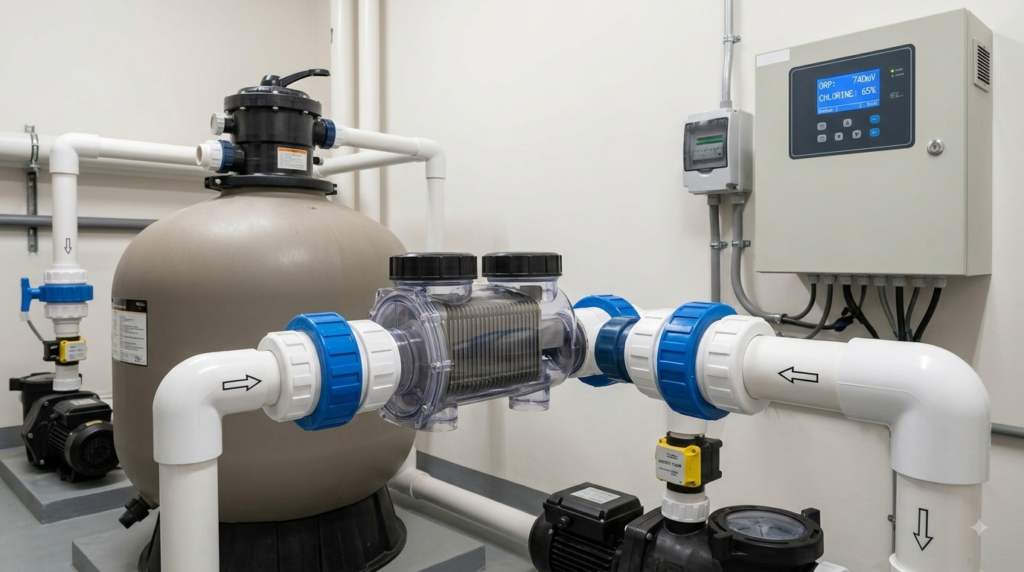
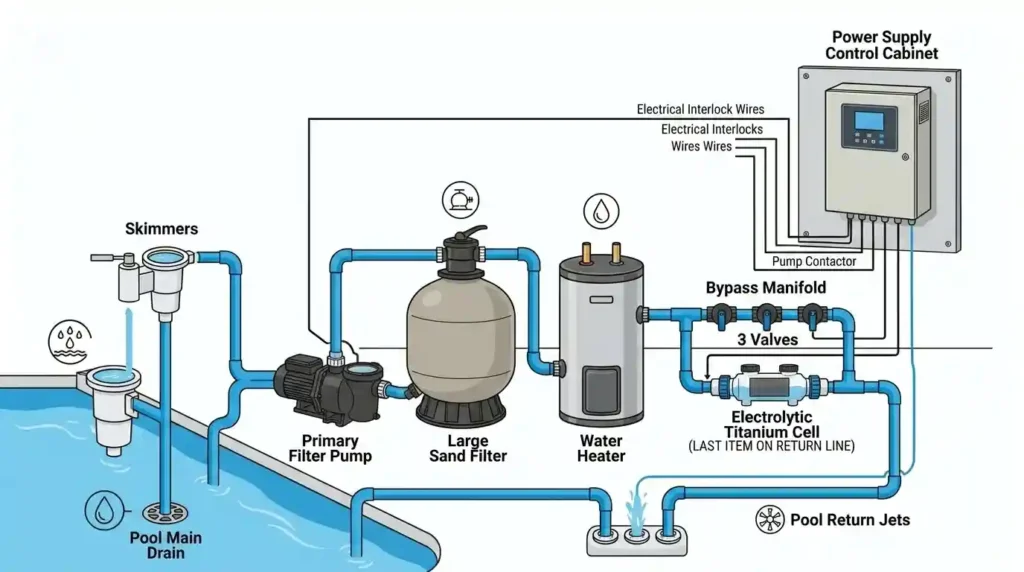
The cell must be the final piece of equipment on the return line before water goes back into the pool. Never place a salt cell before heaters or pumps, as concentrated chlorine will corrode sensitive heat exchangers and impellers.
Never hard-pipe a commercial cell directly into your main line without a bypass manifold. Installing isolation valves allows maintenance personnel to clean or service the cell without taking the entire filtration system offline.
The control box must be electrically wired to the main pump contactor or Variable Frequency Drive (VFD). If the filtration pump stops operating, the chlorinator must lose power instantly to avoid gas accumulation inside the plumbing.
Commercial pools feature stainless steel ladders, light rims, and metal fittings. Installing a sacrificial zinc anode on the return line prevents stray electrical currents and salt water from causing galvanic corrosion on metal pool fixtures.
Maintaining balanced parameters is essential for effective shared pool water treatment. Salt water isn’t maintenance-free; it simply changes how you maintain the water chemistry.
| Parameter | Ideal Target Range | Why It Matters |
|---|---|---|
| Salinity | 3,500 – 4,500 ppm | Required for the electrolytic cell to split salt effectively. |
| Free Chlorine | 2.0 – 4.0 ppm | Destroys pathogens and keeps water safe for bathers. |
| pH Level | 7.2 – 7.6 | Keeps chlorine active and prevents skin irritation. |
| Total Alkalinity | 80 – 120 ppm | Acts as a buffer to keep your pH stable. |
| Cyanuric Acid (CYA) | 30 – 50 ppm | Protects free chlorine from being destroyed by UV sunlight. |
| Calcium Hardness | 200 – 400 ppm | Prevents plaster erosion and scale formation on cell plates. |
As electrolysis occurs, a mild byproduct called sodium hydroxide is released, which slowly causes the water pH to rise. If the pH rises above 7.8, chlorine can lose more than 50% of its sanitizing effectiveness.
To keep your housing society pool chlorinator running at peak efficiency, pair it with an inline pH controller. A probe continuously reads water acidity and automatically triggers a small peristaltic pump to inject diluted acid whenever pH drifts too high.
Instead of running your cell at a fixed percentage, commercial systems rely on Oxidation-Reduction Potential (ORP) sensors. ORP measures the actual sanitizing power of the water in millivolts (mV). When many guests enter the pool at once, the ORP reading drops, instantly telling the chlorinator to increase chlorine production until the target level of 720–750 mV is restored.
To ensure your titanium plates last their full 4 to 6-year operational life, set up a simple maintenance schedule.
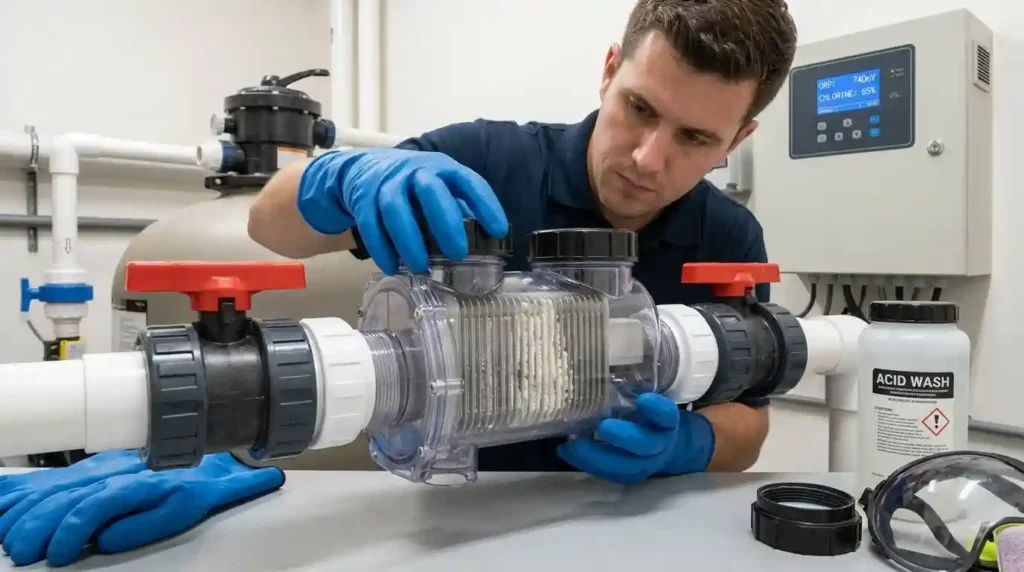
Visual Scaling Check: Inspect the clear cell housing for white calcium deposits on the titanium plates.
Flow Switch Testing: Shut down the main filter pump to confirm that the flow switch cuts power to the controller automatically.
Salinity Check: Test salinity using a digital meter or titration strips, adding salt if backwashing or heavy rain diluted the water.
If calcium scale builds up inside the cell, clean it using a mild acid solution:
Wear protective eyewear, rubber gloves, and work in a well-ventilated space.
Isolate the cell using your 3-valve bypass loop, disconnect the power cable, and unscrew the plumbing unions.
Mix 1 part Hydrochloric (Muriatic) Acid into 4 parts fresh water inside a clean plastic bucket. Always pour acid into water, never water into acid!
Soak the cell plates in the solution for 10 to 15 minutes until the bubbling stops. Rinse thoroughly with fresh tap water and reinstall. Never scrape titanium plates with metal tools, as this strips off the precious metal coating.
Upgrading your sanitation infrastructure to a reliable salt chlorinator system transforms pool management from a daily hassle into a hands-off, cost-effective process—giving residents and resort guests the crystal-clear water they expect.