

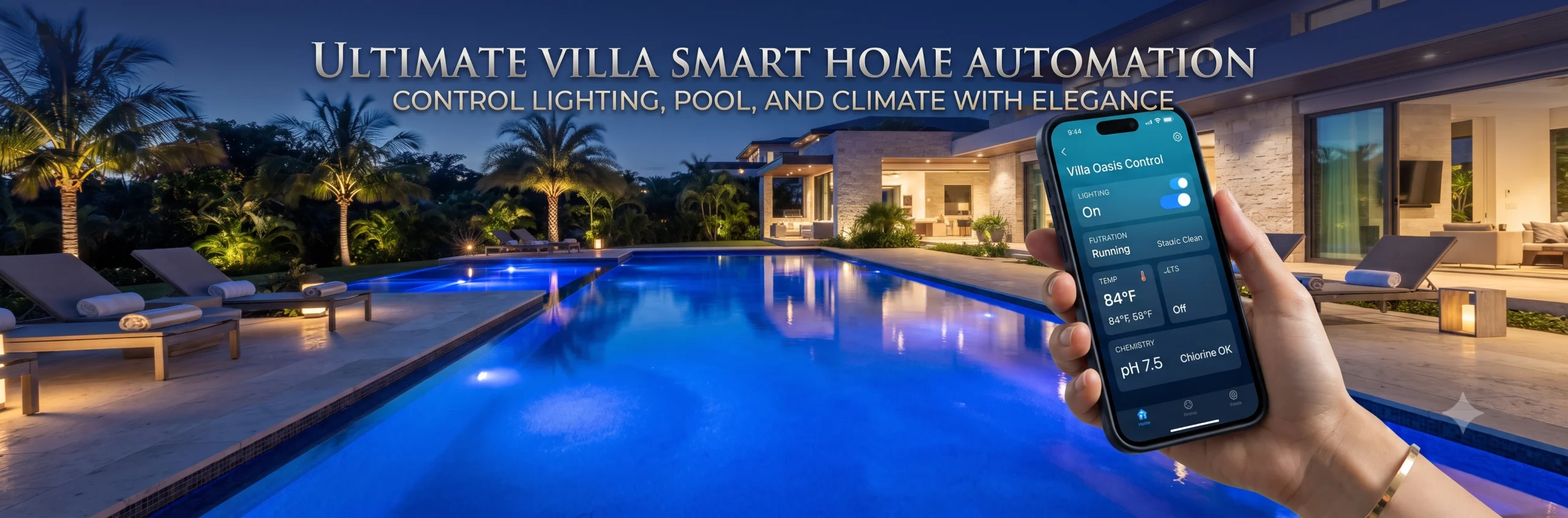
Stepping out onto your villa’s stone patio on a warm afternoon is supposed to be an exercise in pure relaxation. You expect your home to anticipate your comfort—smart climate controls adjust the indoor temperature, motorized security gates slide open smoothly, and architectural landscape lighting awakens at dusk without a single manual switch. Yet, for many luxury homeowners, the crown jewel of the backyard—the swimming pool—remains stuck in the past. Traditional pool care demands daily physical intervention: walking out to the equipment pad, twisting heavy multi-port valves, hauling bulky chemical buckets, and guessing at pump run times. Managing a pristine aquatic retreat without a smart pool automation system for villas quickly turns into an exhausting, high-maintenance chore. Every single villa owner eventually realizes that a smart pool automation system for villas is the only true way to eliminate manual labor. When you rely on a smart pool automation system for villas, your entire backyard transforms into an intelligent sanctuary.
Fortunately, residential technology has evolved to eliminate backyard friction entirely. Integrating an intelligent smart pool automation system for villas takes the guesswork, manual labor, and stress out of water management. Instead of spending your weekends testing water samples or adjusting mechanical timers, you gain absolute mastery over your pool’s filtration, heating, and sanitization parameters from a sleek interface on your smartphone using your smart pool automation system. As a leading manufacturer and supplier of high-performance aquatic technology, Aqvastar delivers advanced smart pool automation system for villas solutions designed to maximize energy efficiency, protect water chemistry, and elevate your daily lifestyle. Every modern property manager knows that a smart pool automation system for villas is essential, and choosing an Aqvastar smart pool automation system for villas ensures unmatched reliability. In this masterclass guide, we will explore the engineering behind a smart pool automation system for villas, examine the core benefits of a smart pool automation system for villas, and demonstrate how a smart pool automation system for villas transforms modern estate management.
At its engineering core, a smart pool automation system for villas functions as the central nervous system of your outdoor aquatic plant room. Traditional swimming pools operate on independent, isolated mechanical components—a pump wired to a basic wall timer, a gas heater with its own manual thermostat, and a chlorinator running on an arbitrary output setting. These disconnected units require constant human supervision to work together effectively, whereas a smart pool automation system for villas handles everything natively.
In contrast, a smart pool automation system for villas consolidates every piece of electrical and mechanical hardware into a single, cohesive digital network. High-voltage relay switches, low-voltage communication modules, and intelligent software hubs work in unison within your smart pool automation system for villas to regulate water flow, temperature, and chemical balance continuously. When you install a smart pool automation system for villas supplied by Aqvastar, sensors embedded in your filtration lines constantly monitor real-time water conditions through your smart pool automation system for villas. If bather loads increase or solar radiation spikes water temperatures, your smart pool automation system for villas automatically responds—adjusting pump speeds, increasing sanitizer output, or activating solar heating valves via the smart pool automation system for villas hub—long before water quality can drift out of balance.
Designing a truly automated villa pool requires a balanced combination of rugged field hardware and responsive digital interfaces, all orchestrated by a smart pool automation system for villas. Every element on the equipment pad plays a specific role when linked to a smart pool automation system for villas in maintaining effortless, crystal-clear water.
Weatherproof Central Controller: The master control enclosure mounted on your plant room wall, housing heavy-duty electrical relays, circuit protection, and secure Wi-Fi or local network transceivers for your smart pool automation system for villas.
Variable-Speed Pump Drives: Intelligent motor controllers that allow your smart pool automation system for villas to ramp motor RPM up or down dynamically depending on whether the pool is filtering, heating, or running spa jets.
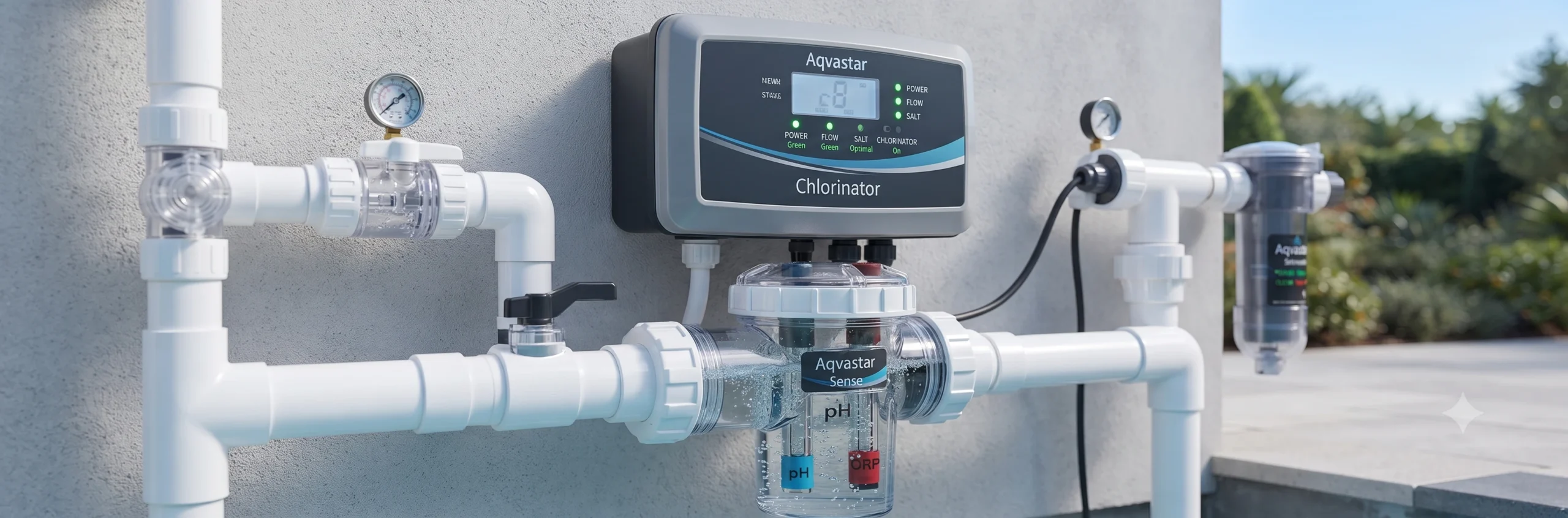
Inline Chemical and Flow Sensors: Precision probes—including pH meters and Oxidation-Reduction Potential (ORP) sensors—that feed real-time water data directly to your smart pool automation system for villas hub.
Motorized Valve Actuators: Automated mechanical actuators managed by your smart pool automation system for villas, mounted onto plumbing lines to switch water circulation seamlessly between the main pool basin, raised spas, water features, and roof solar panels.
Cloud-Connected Mobile Dashboard: The user-friendly smartphone or tablet application linked to your smart pool automation system for villas, granting secure, encrypted access to your entire aquatic setup from anywhere in the world.
Choosing the right equipment manufacturer dictates the long-term reliability of your smart home ecosystem. Aqvastar bridges the gap between raw industrial durability and intuitive digital control, supplying robust smart pool automation system for villas packages tailored for high-end residential architecture that rely entirely on an advanced smart pool automation system for villas.
Legacy single-speed pumps operate at maximum power continuously, driving up electricity bills and wearing out motor bearings prematurely. Aqvastar supplies variable-speed circulation pumps that integrate natively with a smart pool automation system for villas. Your smart pool automation system for villas programs your pump to run at low, whisper-quiet flow rates during extended off-peak filtration hours, and automatically ramps up speed only when high pressure is required for pool cleaning or spa operation via the smart pool automation system for villas. This intelligent modulation slashes pump energy consumption by up to 80% through your smart pool automation system for villas.
Maintaining safe, hygienic water manually involves handling hazardous chlorine compounds and guessing chemical quantities. Aqvastar supplies advanced salt water chlorinators and digital dosing pumps that interface smoothly with your smart pool automation system for villas. The smart pool automation system for villas tracks sanitization demand dynamically, generating pure active chlorine inline or adjusting pH levels automatically to ensure your pool remains bath-ready without manual intervention, all managed by the smart pool automation system for villas.
Villa pools double as stunning visual centerpieces after dark. Aqvastar supplies high-lumens, energy-efficient underwater LED lighting systems wired directly into automation relay panels controlled by a smart pool automation system for villas. Through your smart pool automation system for villas mobile app, you can orchestrate complex color transitions, schedule automated evening lighting scenes, or dim illumination levels to match your mood for outdoor entertaining.
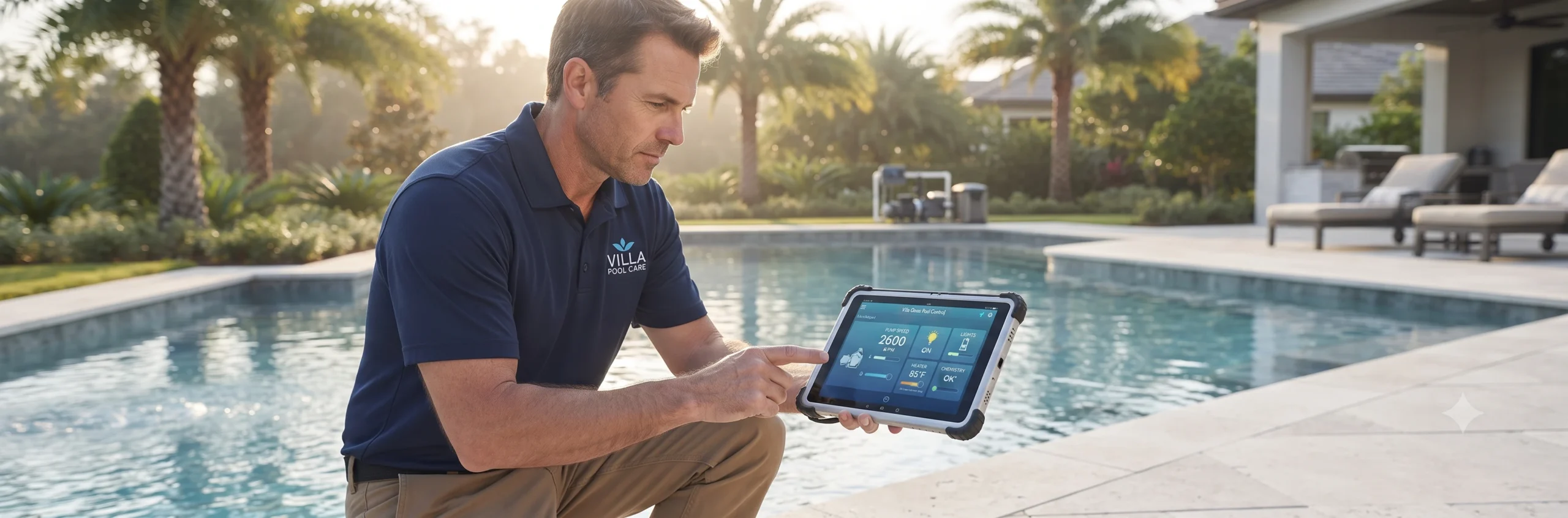
Implementing a smart pool automation system for villas is most effective when integrated during the initial architectural design or major backyard renovation phase. Follow this structured roadmap to ensure flawless execution of your smart pool automation system for villas:
Audit Equipment Pad Requirements: Catalog every electrical load on your equipment pad—including circulation pumps, auxiliary booster pumps, gas heaters, heat pumps, salt chlorinators, spa blowers, and landscape lighting—to determine relay requirements for your smart pool automation system.
Select the Master Controller: Specify an Aqvastar automation panel equipped with sufficient high-voltage and low-voltage ports to manage your immediate setup, while leaving spare relay channels for future additions managed by your smart pool automation system for villas.
Verify Outdoor Wireless Connectivity: Ensure robust Wi-Fi, Ethernet, or cellular signal penetration reaches your plant room enclosure so your smart pool automation system for villas communicates with zero packet loss or latency.
Install Motorized Valve Actuators: Mount heavy-duty valve actuators on your suction and return manifolds, integrating them seamlessly into your smart pool automation system for villas if your villa design incorporates an attached spa or raised infinity edge.
Calibrate Inline Water Probes: Position flow switches and pH/ORP sensors downstream from your filtration and heating equipment, ensuring adequate mixing distance before connecting them to the Aqvastar smart pool automation system for villas control hub.
Program Custom Operational Profiles: Configure your smart pool automation system for villas mobile dashboard to execute low-speed filtration during off-peak night electricity tariff windows, set automated cleaning cycles, and program custom lighting presets.
Upgrading a luxury property with a smart pool automation system for villas delivers profound lifestyle enhancements alongside measurable financial returns.
Unmatched Remote Management: Check water temperatures, fire up spa heaters, and adjust patio lighting from anywhere using your smart pool automation system.
Dramatic Utility Cost Reductions: Running variable-speed pumps at optimized low flow rates through a smart pool automation system for villas significantly lowers monthly electricity consumption.
Instant System Health Notifications: Receive immediate push alerts on your phone via your smart pool automation system for villas if filter pressure climbs past safe thresholds or chemical parameters shift.
Maximized Equipment Longevity: Built-in thermal protection, controlled hydraulic ramp-up times, and precise chemical dosing managed by a smart pool automation system for villas eliminate aggressive wear-and-tear.
Immaculate Water Purity: Continuous automated sanitization driven by a smart pool automation system for villas halts microscopic algae blooms before they materialize, guaranteeing crystal-clear water 365 days a year.
To ensure your smart pool automation system operates with flawless reliability, steer clear of these frequent engineering mistakes:
Neglecting Outdoor Signal Strength: Placing automation control boxes inside subterranean or heavily reinforced concrete plant rooms without external antenna extensions frequently causes dropped network connections for your smart pool automation system for villas.
Improper Relay Sourcing: Attempting to wire high-amperage pool pumps directly into low-voltage control boards without intermediary contactor relays will permanently damage your smart pool automation system for villas hardware.
Poor Sensor Placement: Installing chemical testing probes immediately adjacent to chemical injection points without a proper mixing loop causes erratic sensor readings within your smart pool automation system for villas.
Skipping Routine Probe Maintenance: Digital pH and ORP sensors linked to your smart pool automation system for villas demand periodic cleaning to clear mineral scale and occasional calibration.
Maintaining a luxury swimming pool should always be an absolute pleasure, never a burdensome daily chore. Investing in a smart pool automation system for villas brings intelligence, operational efficiency, and effortless convenience directly to your outdoor living space. By automating filtration timetables, optimizing energy draw, and sustaining precise chemical equilibrium in real time, a smart pool automation system for villas protects your property investment while ensuring immaculate water quality at all times through your trusted smart pool automation system for villas.
With Aqvastar as your trusted equipment manufacturer and supplier, outfitting your villa with high-performance automation hardware via a smart pool automation system for villas is straightforward and dependable. Elevate your property today with Aqvastar’s intelligent smart pool automation system for villas solutions and experience the absolute peak of modern luxury aquatic management powered by a state-of-the-art smart pool automation system for villas.
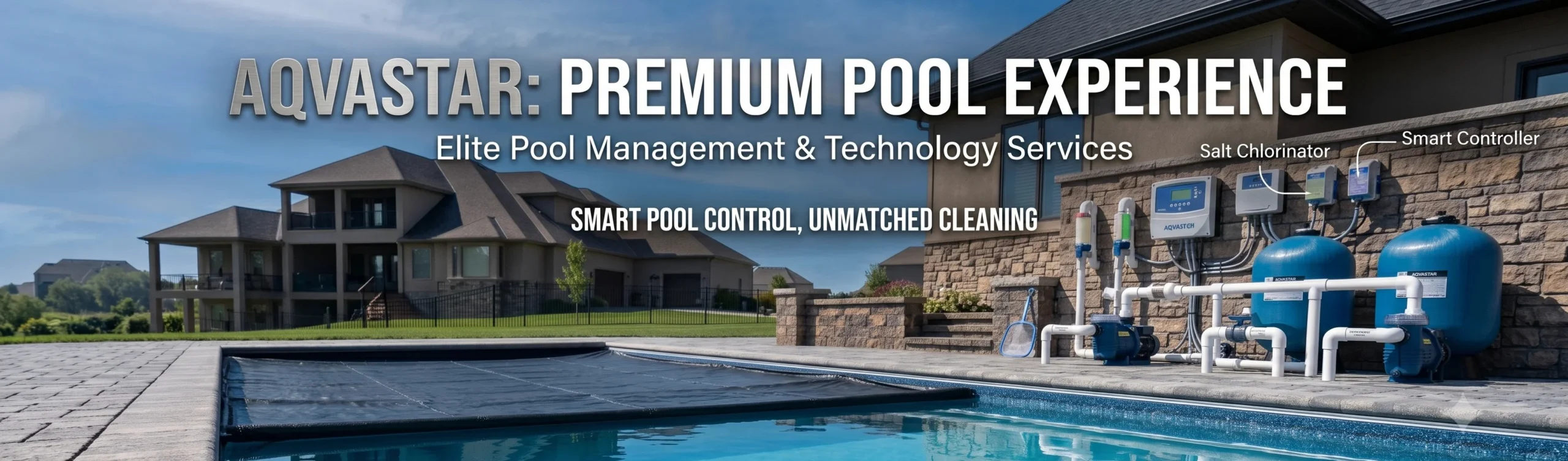
Building or managing a swimming pool is a major investment that adds immense luxury, recreational value, and aesthetic appeal to any residential housing society, luxury hotel, or private estate. However, the concrete shell and sparkling surface are only the visible parts of a much larger system. The true longevity, hygiene, and clarity of your pool water depend on what happens inside the mechanical plant room. Installing high-performance swimming pool equipment is essential to keep water continuously moving, physically clean, and biologically safe for bathers.
Without properly specified swimming pool equipment, standing water quickly turns stagnant. Dust, organic matter, leaves, and swimmer waste build up, creating an environment where algae and harmful bacteria thrive. Selecting heavy-duty, energy-efficient swimming pool equipment supplied by Aqvastar ensures your pool operates smoothly with minimal downtime, low chemical consumption, and optimal power savings.
Whether you are designing a brand-new commercial pool or upgrading an aging filtration system, this comprehensive masterclass covers everything you need to know about choosing, sizing, and maintaining your pool hardware.
To understand how a plant room functions, it helps to look at swimming pool equipment not as individual, standalone items, but as an interconnected ecosystem. Every pump, filter vessel, and chlorinator cell works in unison to maintain pristine water conditions.
When you specify professional swimming pool equipment supplied by Aqvastar, your facility achieves four core operational goals:
Hydraulic Water Circulation: Pushing water through continuous cycles eliminates dead spots where algae and bacteria gather.
Mechanical Solid Filtration: Trapping suspended organic silt, dust, hair, and debris down to fine micron levels before it can compromise clarity.
On-Site Chemical Disinfection: Generating a steady baseline of active sanitizer to neutralize bacteria, viruses, and pathogens on contact.
Basin Water Balance & Protection: Keeping pH, total alkalinity, and calcium hardness balanced to protect internal pipework and pool surfaces from corrosion or scale buildup.
Understanding how pool hardware works together does not require an engineering degree. Water movement follows a simple, continuous loop through your installed swimming pool equipment.
The process starts directly inside the pool basin. Water enters the suction line through floor main drains and wall-mounted skimmers. The heavy-duty Aqvastar circulation pump supplies the suction required to pull raw water to the equipment pad, passing it first through an internal strainer basket to catch larger debris like leaves.
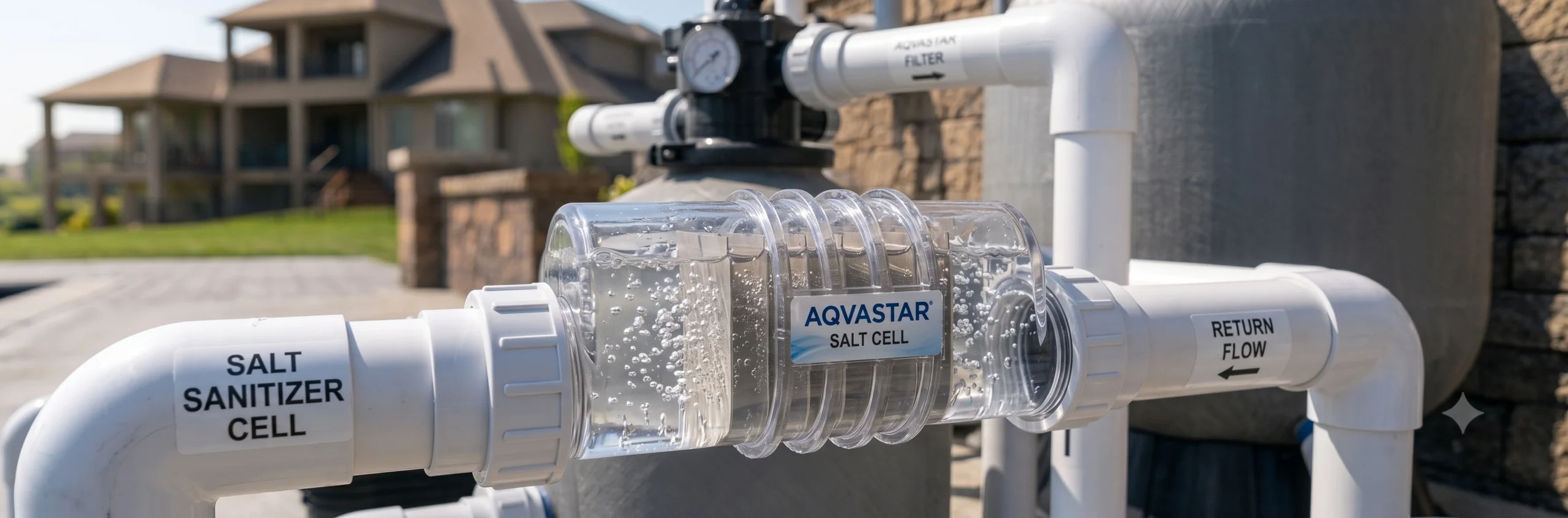
Next, the pump pushes this water under pressure into the top of the Aqvastar sand filter vessel. As water flows downward through specialized filter media, fine particles and suspended dirt become trapped. The clean, filtered water exits through the bottom of the vessel and moves downstream to the Aqvastar salt chlorinator cell. Here, low-voltage electrolysis generates pure active sanitizer to disinfect the water inline. Finally, the crystal-clear, sanitized water flows back into the pool through return wall jets, completing the cycle.
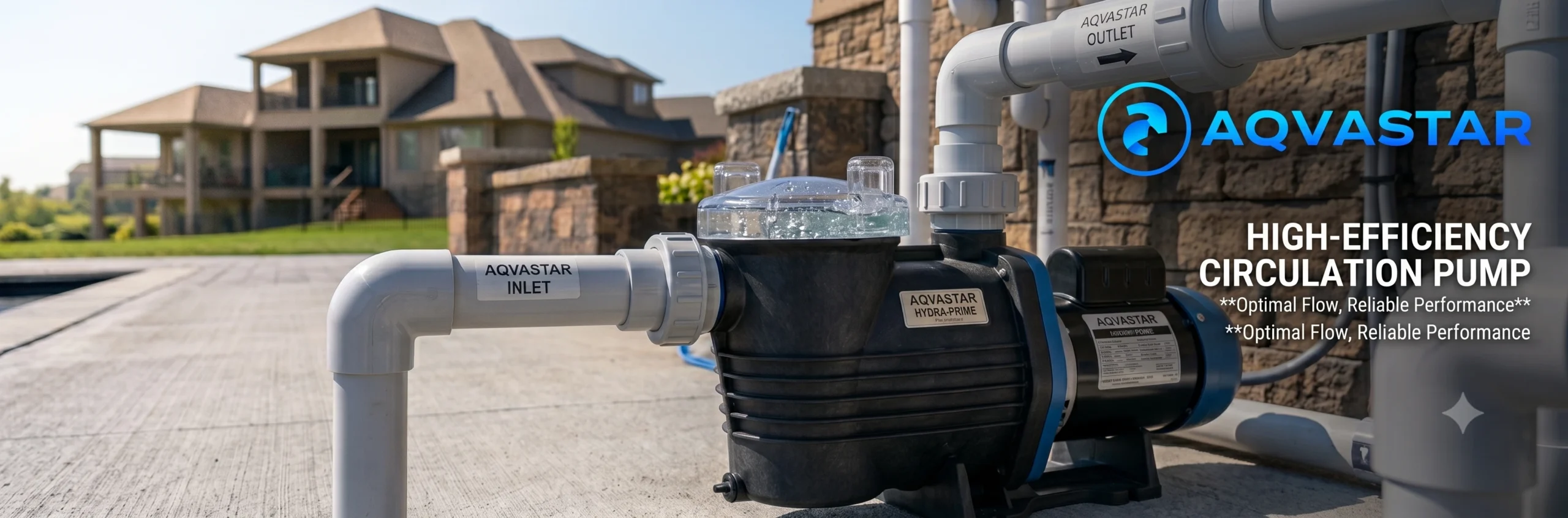
Aqvastar manufactures and supplies a complete range of commercial and residential swimming pool equipment built to withstand heavy daily use, harsh sunlight, and chemical exposure.
The pump is the heart of your mechanical setup. It runs for long hours every day, pulling water from the basin and pushing it through filters and treatment devices. An undersized pump causes cloudy water and poor turnover, while an inefficient pump inflates monthly electricity costs.
Aqvastar supplies self-priming circulation pumps engineered with non-corrosive thermoplastic housings, stainless steel shaft seals, and integrated thermal protection. Designed for silent operation and maximum hydraulic efficiency, Aqvastar circulation pumps handle heavy operating loads easily.
While pumps drive water movement, filter vessels handle physical purification. Sand filters remain the industry gold standard due to their high dirt-holding capacity, structural durability, and easy maintenance.
Aqvastar supplies heavy-duty, fiberglass-reinforced sand filter tanks equipped with multi-port control valves. These valves let pool operators backwash, rinse, recirculate, or bypass water with a simple lever turn. Internal lateral underdrains ensure even water flow across the filter bed, capturing fine particles down to 20 microns.
Manually handling, storing, and pouring liquid chlorine or chemical pucks is costly, labor-intensive, and hazardous for staff. Modern residential societies and commercial resorts prefer automated, on-site chlorination.
Aqvastar supplies advanced automated salt water chlorinators that convert dissolved pool salt into active sanitizer inline. As salted water flows across self-cleaning titanium plates inside the cell, pure chlorine is created continuously. This eliminates harsh chemical odors, prevents eye sting, and delivers soft, skin-friendly water for swimmers.
Underwater lighting provides critical night visibility for swimmer safety while transforming a dark body of water into an elegant evening landscape feature.
Aqvastar supplies ultrabright LED underwater lights available in daylight white and multi-color RGB options. Sealed inside leak-proof polycarbonate or stainless steel housings, Aqvastar LED lights consume up to 80% less power than traditional halogen bulbs while delivering broad, uniform illumination across the pool floor.
Proper hydraulic performance depends heavily on the fittings embedded directly into the pool structure. Poorly positioned main drains or skimmers create circulation dead zones and suction hazards.
Aqvastar supplies a complete line of heavy-duty ABS plastic fittings, including anti-vortex floor main drains, surface skimmers, adjustable return jets, and wall vacuum ports. Built to meet international safety standards, Aqvastar fittings ensure smooth water distribution and anti-entrapment safety for swimmers.
Even automated pools need periodic physical brushing and vacuuming to clear windblown dust and settled floor silt.
Aqvastar supplies professional-grade manual cleaning tools, including aluminum telescopic poles, heavy-duty leaf rakes, vacuum hoses, weighted floor vacuum heads, and wall brushes. For large installations, Aqvastar also supplies automated robotic cleaners that scrub floors and walls independently, reducing manual labor.
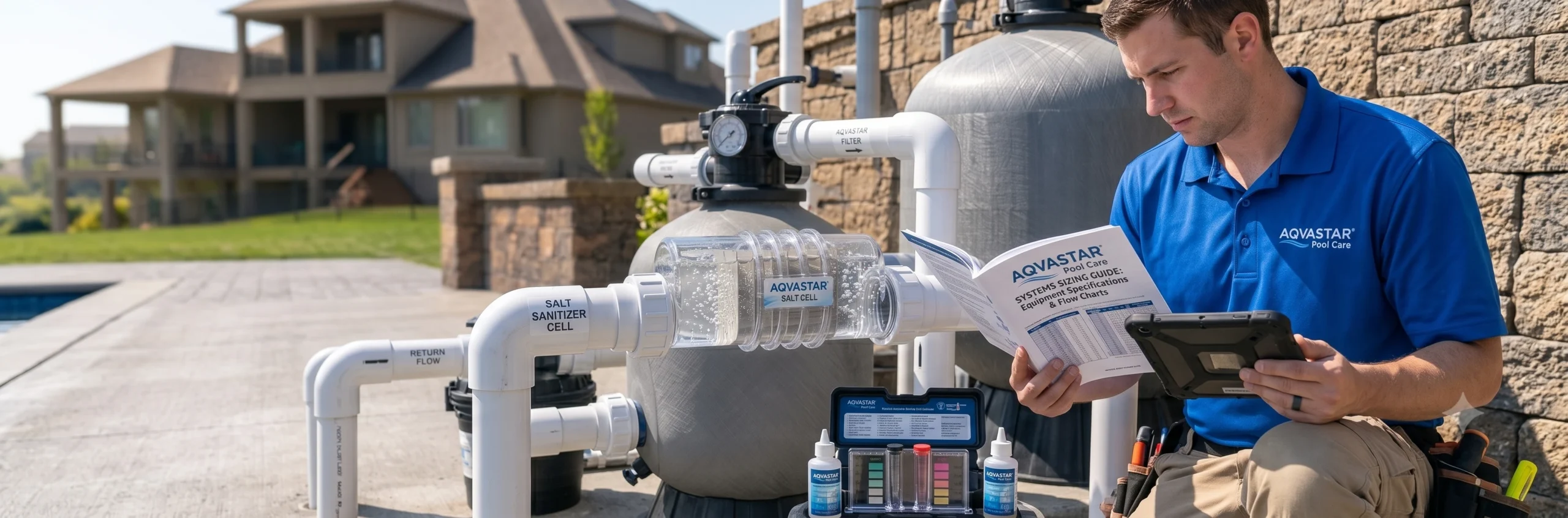
Installing incorrectly sized swimming pool equipment can lead to cloudy water, poor filtration, higher electricity bills, and premature equipment failure. To maintain efficient circulation and reliable water quality, the pump, filter, and salt chlorinator should be selected according to the pool’s actual water volume and operating requirements.
Start by calculating the total amount of water in the swimming pool. Pool volume is generally measured in liters (L) or cubic meters (m³).
For a standard rectangular swimming pool, use:
Pool Volume (Liters) = Length × Width × Average Depth × 1,000
For example, if a pool is 10 m long, 5 m wide, and has an average depth of 1.5 m:
10 × 5 × 1.5 × 1,000 = 75,000 liters
Therefore, the total pool volume is 75,000 liters or 75 m³.
Turnover time refers to the number of hours required for the filtration system to circulate a volume of water equal to the entire pool volume.
For most residential swimming pools, a turnover time of approximately 6–8 hours is commonly used.
For commercial pools, housing societies, hotels, and resorts, a shorter turnover time of approximately 4–6 hours may be required because of higher bather loads and more intensive pool usage.
The appropriate turnover time should also comply with applicable local regulations and the pool’s operating conditions.
Once you know the pool volume and desired turnover time, calculate the required flow rate.
Required Flow Rate (m³/h) = Pool Volume (m³) ÷ Turnover Time (hours)
For example, for a 75 m³ pool with a target turnover time of 6 hours:
75 ÷ 6 = 12.5 m³/h
This means the circulation system should be designed to deliver approximately 12.5 cubic meters of water per hour, subject to the actual hydraulic resistance of the plumbing and equipment.
The swimming pool filter should be properly matched to the system’s required flow rate.
Select an Aqvastar sand filter with a rated flow capacity suitable for the calculated system flow. Avoid connecting a high-output pump to an undersized filter vessel.
Excessive water velocity through an undersized filter can reduce filtration performance, disturb the filter media, increase pressure, and potentially shorten the service life of the filtration system.
For reliable performance, the pump and filter should be sized as a complete circulation system rather than selected independently.
The salt chlorinator should also be selected according to the pool volume, operating conditions, climate, and expected chlorine demand.
As a practical sizing approach, an Aqvastar salt chlorinator can be selected with additional capacity above the pool’s actual volume. For example, selecting a system rated for around 1.5 times the actual pool volume can provide useful operating headroom where appropriate.
A larger-capacity chlorinator does not necessarily need to operate continuously at maximum output. Running the system at a lower percentage output may reduce operating stress on the electrolytic cell while still maintaining the required chlorine level.
However, actual chlorine demand can vary significantly depending on water temperature, sunlight, bather load, pool usage, stabilizer level, and water chemistry, so the final chlorinator size should be based on site conditions.
Correct swimming pool equipment sizing is about creating a balanced system. The pump, sand filter, plumbing, and salt chlorinator should all work together at an appropriate flow rate.
Before selecting equipment:
Calculate Pool Volume → Determine Turnover Time → Calculate Flow Rate → Match Pump & Filter → Select Salt Chlorinator Capacity
Proper equipment sizing helps deliver clearer pool water, efficient filtration, lower energy consumption, reliable chlorination, and longer equipment life.
Protect your swimming pool equipment investment by avoiding these common installation and operational errors:
Placing Salt Cells Upstream of Heaters: Always install your Aqvastar salt chlorinator cell as the final component on the return line. Placing a cell before a heater exposes internal copper exchangers to concentrated sanitizer, causing severe corrosion.
Operating Pumps Dry: Never start a circulation pump without filling its strainer basket with water first. Operating a pump dry generates friction heat that ruins mechanical shaft seals instantly.
Ignoring Filter Pressure Gauges: Failing to backwash sand filters when operating pressure rises 8 to 10 PSI above baseline restricts water flow, reduces turnover efficiency, and strains pump motors.
Unbalanced Water Chemistry: Operating pool water with low pH (below 7.0) corrodes metal pump impellers and heater components, while high pH causes rapid scaling inside filter tanks and chlorinator cells.
Investing in high-quality swimming pool equipment is the foundation of clear water, swimmer safety, and low long-term operating costs. From heavy-duty circulation pumps and filtration sand vessels to automated salt chlorinators and brilliant underwater LED lighting, every component plays a vital role in maintaining your pool.
With Aqvastar as your equipment manufacturer and supplier, outfitting your plant room is straightforward and dependable. Whether constructing a new private villa pool, upgrading a housing society pad, or managing a high-density resort facility, Aqvastar supplies the complete range of swimming pool equipment needed to keep water crystal clear every day of the year.
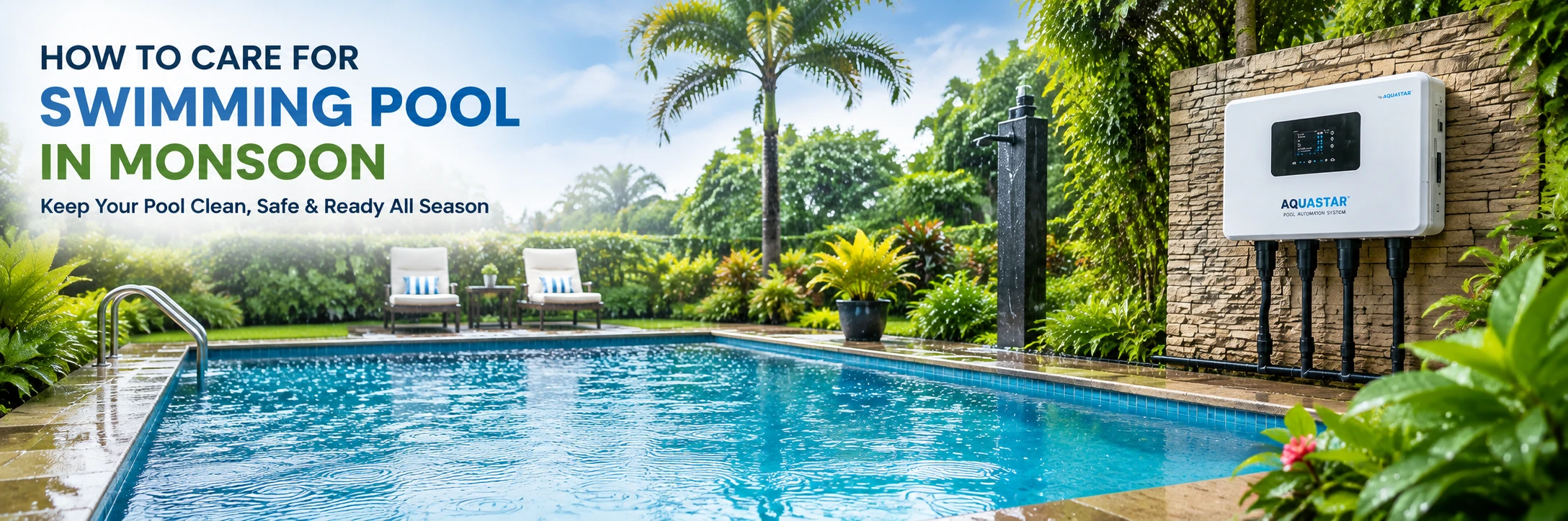
The monsoon season brings a welcome break from scorching summer temperatures, but for pool owners, it brings a fresh set of operational challenges. Heavy downpours, high humidity, and atmospheric pollutants can quickly transform a sparkling pool into a cloudy, green headache overnight. Rainwater dilutes essential sanitizers, alters water chemistry, and introduces organic debris, creating ideal conditions for algae blooms and bacterial growth.
If you are wondering how to care for swimming pool in monsoon weather without spending hours on exhausting manual labor, you are in the right place. Proper rain-season maintenance goes beyond skimming floating leaves—it requires a proactive strategy encompassing water drainage, balanced chemistry, structural protection, and efficient filtration.
In this comprehensive guide, we break down the essential maintenance steps to keep your pool crystal clear all season long, while explaining how partnering with Aquastar can automate and simplify your pool care routine.
Understanding the direct impact of rainwater on pool water quality is the first step toward effective seasonal maintenance. Rainwater is naturally acidic and absorbs atmospheric dust, nitrogen, pollen, and fungal spores as it falls. When hundreds or thousands of gallons of rainwater mix with your pool water, several immediate shifts occur:
Chemical Dilution: The sheer volume of incoming rainfall lowers free chlorine levels, stabilizer concentrations, and overall salinity.
pH Drop: Acidic rainfall disrupts your pool’s natural pH and total alkalinity buffers, causing water to become corrosive.
Organic Overload: Storm winds wash garden runoff, dirt, dead leaves, and insects directly into the pool vessel.
Algae Growth: Airborne algae spores introduced by monsoon winds thrive in warm, low-chlorine environments, turning water cloudy or green within hours.
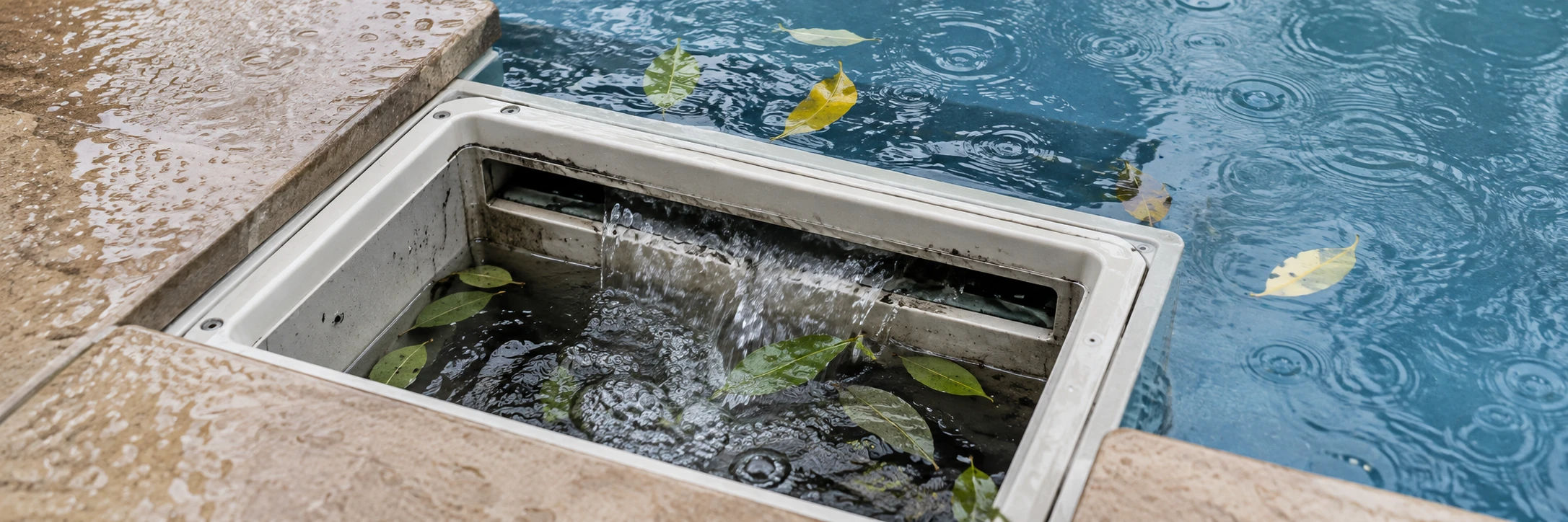
Managing a swimming pool during heavy rainfall does not have to be overwhelming if you follow a structured maintenance checklist.
| Maintenance Area | Typical Monsoon Problem | Immediate Action Required |
|---|---|---|
| Water Level | Excessive accumulation, overflow risk | Run multi-port valve on Waste or Drain setting |
| Water Chemistry | Free chlorine drops, pH shifts acidic | Double shock pool; add pH increaser (Soda Ash) |
| Filtration System | Clogged baskets, high filter pressure | Backwash sand filter; run pump 12–16 hours/day |
| Algae Prevention | Green water, slippery plaster surfaces | Apply weekly preventive dose of non-foaming algaecide |
| Physical Shell | External groundwater pressure risk | Maintain internal water weight; check relief valves |
Heavy downpours cause pool water levels to rise rapidly. When water levels exceed the midpoint of your skimmer hatch, the skimmer loses its skimming action and cannot draw floating debris off the surface. If water overflows over the coping stone, ground soil and dirty garden runoff wash directly into your pool.
Check water levels daily during active storm cycles. Use your filter’s multi-port valve on the Waste or Drain setting to lower the water level back to the middle of the skimmer box. Never let water sit higher than three-quarters of the way up the skimmer mouth.
Rainwater acts as a constant dilutant. Testing your water twice a week during the monsoon is critical to maintain essential sanitation parameters.
| Water Parameter | Ideal Target Range | Monsoon Impact & Action Step |
|---|---|---|
| Free Chlorine | 2.0 – 4.0 ppm | Drops rapidly due to organic load. Maintain near 4.0 ppm. |
| pH Level | 7.2 – 7.6 | Drops due to acidic rain. Add Soda Ash when pH falls below 7.2. |
| Total Alkalinity | 80 – 120 ppm | Buffers pH swings. Add Sodium Bicarbonate if below 80 ppm. |
| Cyanuric Acid (CYA) | 30 – 50 ppm | Dilutes over time. Replenish stabilizer after heavy rain cycles. |
Do not wait for your water to turn cloudy or green before taking action. Superchlorinating (shocking) your pool before and immediately after heavy storms raises free chlorine levels to 10 ppm, destroying organic contaminants before algae can take root.
In addition to shocking, apply a weekly preventive dose of a high-purity, non-foaming polyquat algaecide. This provides a reliable backup shield against stubborn green, yellow, and black algae strains.
During monsoon months, your filtration system works twice as hard to clear suspended silt and fine debris. Increase your daily filtration cycle from the standard 8 hours to 12–16 hours per day. During multi-day storm events, consider running your pump continuously.
Keep a close eye on your filter pressure gauge. Clean cartridge filters or backwash sand filters whenever operating pressure rises 8 to 10 PSI above clean baseline pressure to prevent pump strain.
Monsoon rainfall saturates the ground around your pool, causing groundwater levels to rise significantly. This groundwater exerts upward force, known as hydrostatic pressure, against the outside of your pool shell.
If a pool is partially or fully drained during the monsoon season, this external groundwater pressure can cause concrete shells to crack or fiberglass pools to shift out of the ground.
Maintain Internal Water Weight: Never drain your pool below normal operating levels during monsoon months. The weight of the water inside acts as a counterweight against external soil pressure.
Inspect Relief Valves: If your pool is equipped with a hydrostatic relief valve at the main drain, ensure it remains free of debris so groundwater can safely equalize if necessary.
Heavy rain and outdoor electrical equipment require careful monitoring to prevent short circuits and component damage.
Elevate Circulation Equipment: Ensure your filtration pump sits elevated on a concrete slab rather than directly on soil, preventing standing rainwater from surrounding the motor housing.
Inspect Control Enclosures: Verify that all outdoor automation panels and timer boxes have intact weatherproof seals to prevent moisture intrusion.
Check Grounding and Outlets: Test all Ground Fault Circuit Interrupter (GFCI) outlets monthly to ensure complete electrical safety around wet pool decks.
Once the rainy season concludes, transition your pool back to its standard operational schedule:
Deep Clean Filter Media: Perform an extended backwash cycle on sand filters or soak cartridge elements in a specialized cleaning solution to remove accumulated oils and organic silt.
Rebalance Key Chemistry: Bring Total Alkalinity back to 80–120 ppm, adjust pH to 7.2–7.6, and replenish Cyanuric Acid to 30–50 ppm.
Normalize Pump Cycles: Return your pump run times to standard 8-hour daily operational schedules and adjust sanitization output accordingly.
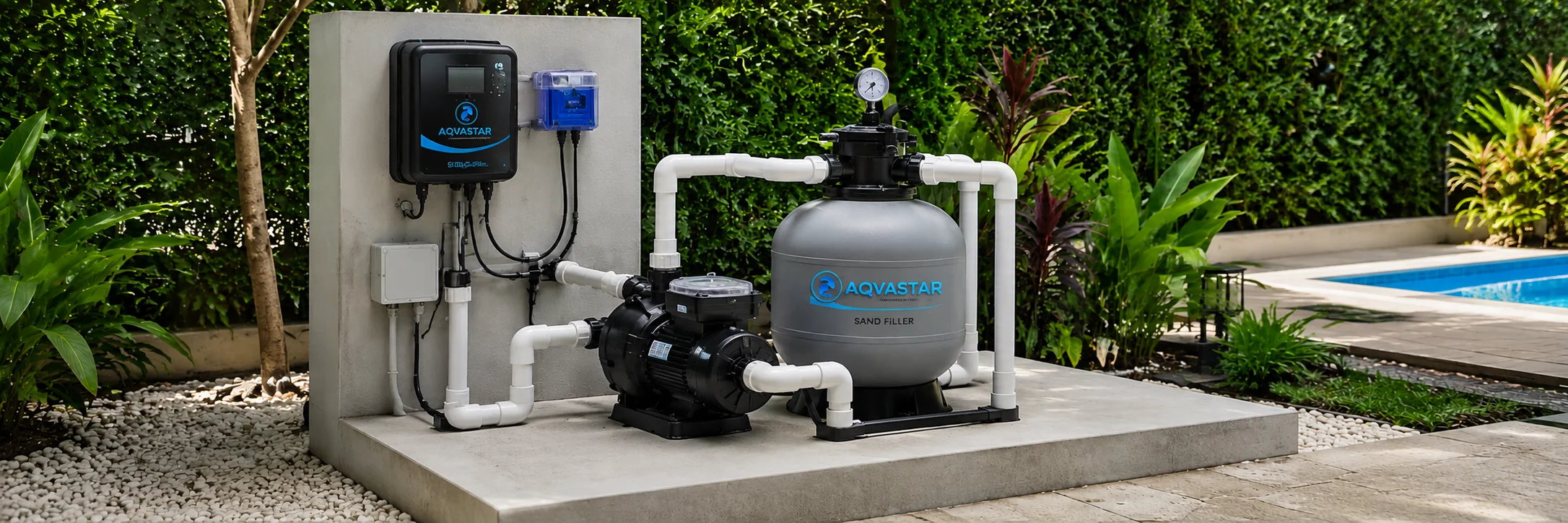
Managing water balance, clearing heavy debris, and sourcing high-grade chemicals throughout the rainy season can become a demanding chore. This is where Aqvastar makes pool ownership completely stress-free.
Aquastar provides complete end-to-end swimming pool solutions—from advanced automated equipment to professional pool care services. Here is how Aqvastar supports your pool during the monsoon season and beyond:
Instead of manually testing water and adding chemical chlorine after every rainstorm, Aquastar offers state-of-the-art automatic salt chlorinators and smart dosing systems. These automated units monitor sanitizer levels continuously and generate pure active chlorine on demand, keeping your pool sanitized even during heavy downpours.
Aquastar equips pools with high-performance sand filters, cartridge filters, and energy-efficient variable-speed pumps. Engineered to handle heavy organic loads, Aquastar’s filtration systems remove fine suspended particles quickly, preventing cloudy water before it starts.
If you prefer hands-off pool care, Aquastar’s team of trained pool technicians offers specialized monsoon maintenance packages. From precision chemical balancing and deep vacuuming to hydrostatic pressure checks and green-to-clean storm recovery, Aquastar ensures your pool remains safe, hygienic, and pristine.
Knowing how to care for swimming pool in monsoon conditions comes down to consistent, proactive care: controlling water levels, maintaining strong sanitizer baselines, extending filtration hours, and protecting your pool shell against hydrostatic pressure. By implementing these essential steps, you can protect your investment and maintain clear, inviting water throughout the rainy season.
With Aqvastar as your trusted pool care partner, managing your pool during the monsoon is simple and hassle-free. From automated salt chlorinators and high-efficiency filters to expert professional maintenance services, Aquastar delivers reliable, crystal-clear results all year round.
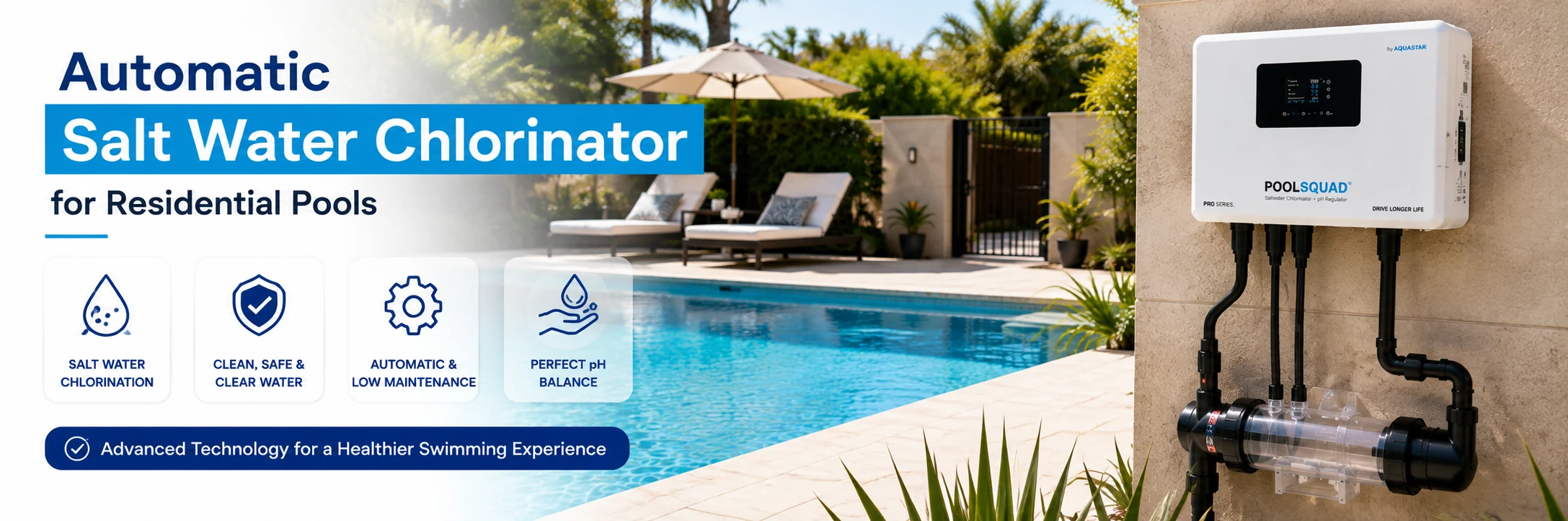
Imagine stepping out into your backyard on a warm, sunny afternoon, ready for a refreshing swim, only to be met by a sharp chemical smell and cloudy water. You grab your water testing kit, discover your free chlorine level has plunged to zero, and realize you need to haul heavy jugs of liquid bleach or dump dusty bags of chlorine shock into the pool. For decades, this demanding manual routine was accepted as an inescapable part of pool ownership. Today, thousands of homeowners are transforming their outdoor maintenance by upgrading to an automatic salt water chlorinator for residential pool sanitization.
Instead of buying, transporting, and manually dosing chemical chlorine every few days, an automated salt generator creates active chlorine continuously within your pool’s plumbing loop. By passing mildly salted water over electrically charged titanium plates, the system generates pure active sanitizer that keeps your water sparkling clear, gentle on your skin, and inviting all season long. Whether you are building a brand-new backyard retreat or upgrading an existing filtration setup, understanding how an automated salt chlorinator works will help you achieve clean water with minimal hassle.
An automatic salt chlorinator—frequently referred to as a salt chlorine generator—is an inline sanitization unit that produces active chlorine on demand using a continuous process called electrolysis. A widespread misconception among home pool owners is that a salt water pool is chemical-free or filled with water as salty as the ocean. In truth, a residential pool utilizing an automatic salt water chlorinator for residential pool care operates at a very low salinity level, usually maintaining a concentration between 3,000 and 4,000 parts per million. To put that into perspective, ocean water has a salinity of approximately 35,000 parts per million, while human tears sit around 9,000 parts per million. Consequently, salt water in a home pool tastes neutral and feels noticeably soft against your skin.
The primary function of an automatic salt generator is to eliminate the constant manual addition of factory-packaged chlorine products. The system creates hypochlorous acid—the exact same active sanitizing agent found in liquid bleach or chlorine pucks—right on site inside your plumbing lines. As the sanitizing agent circulates through your pool, it neutralizes bacteria, algae, and organic contaminants before reverting back into dissolved salt. Because the salt continuously recycles itself through this natural electrochemical loop, facility managers and homeowners rarely need to replenish it unless water is lost due to heavy splash-out, filter backwashing, or torrential rain.
Traditional chemical pool management requires delicate timing and frequent physical intervention. When you manually pour liquid chlorine or place trichlor pucks in a skimmer basket, chlorine levels spike sharply and then drop rapidly over the next few days. During peak summer heat or after a large family pool party, sanitizer levels can drop to zero before you notice, giving algae a chance to bloom rapidly.
An automated salt chlorination system solves this problem by producing a steady, predictable supply of sanitizer whenever your filtration pump operates. Rather than dealing with harsh chemical surges, your pool maintains a flat, stable level of active sanitizer. This constant baseline keeps your water clear without requiring you to store gallons of corrosive liquid or stacks of chemical tubs in your garage.
Furthermore, traditional chemical chlorine often leaves behind chemical byproducts known as chloramines. Chloramines form when free chlorine combines with swimmer waste like sweat, body oils, and cosmetics. They are the true culprit behind stinging red eyes, dry skin, bleached swimwear, and that overwhelming chemical smell often associated with public pools. As pool water recirculates through the high-energy electrolytic cell of a salt chlorinator, the electric arc breaks down chloramines continuously. The result is clean, odor-free water that leaves skin feeling smooth rather than dry and irritated.
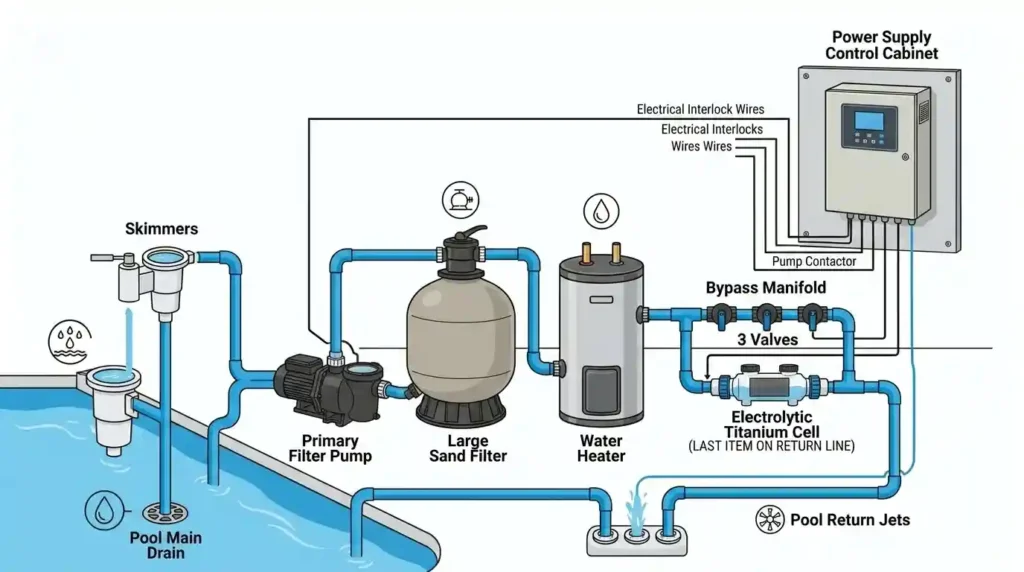
Understanding the mechanics of an automated salt chlorination system does not require an engineering background. The system integrates smoothly into a pool’s existing equipment pad, consisting of three primary components: a wall-mounted power controller, an inline electrolytic titanium cell, and a mechanical safety flow switch.
The process begins when you dissolve pure pool-grade salt into the main body of pool water. As your filtration pump operates, it pulls water from the skimmer and main drain, pushing it through the filter to catch dirt, leaves, and fine debris. Next, the clean water flows through any installed heating equipment such as a gas heater or heat pump. Finally, the water passes through the electrolytic cell housing before returning to the pool through the wall return jets.
Inside the housing of the salt cell, multiple parallel titanium plates receive a safe, low-voltage electric current from the wall controller. As the salted water passes across these electrified plates, the low voltage splits dissolved sodium chloride and water molecules apart. This reaction instantly creates hypochlorous acid, which enters the pool through the return jets to sanitize the water. Once the hypochlorous acid finishes destroying algae and bacteria, it transforms back into dissolved salt, ready to repeat the process during the next pump cycle.
Choosing the correct capacity is one of the most critical steps when buying an automatic salt water chlorinator for residential pool applications. Chlorinators are rated by the maximum number of gallons they can treat, such as 15,000, 25,000, or 40,000 gallons. A common mistake among homeowners is purchasing a chlorinator rated for their exact pool volume. For example, installing a 20,000-gallon capacity cell on a 20,000-gallon pool means the unit will have to run at 100% power output for long hours during hot weather to meet sanitization demand.
A helpful guideline used by experienced pool builders is the 1.5x capacity rule. You should select a salt generator that is rated for at least 1.5 times the actual volume of your pool. If your home swimming pool holds 18,000 gallons of water, you should opt for a chlorinator rated for 25,000 to 30,000 gallons.
Oversizing the unit allows you to run the chlorinator at a lower output setting, such as 40% or 50% capacity, under normal conditions. Running the equipment at lower output significantly extends the overall operational life of the titanium plates, saves electricity, and provides reserve capacity when you host pool parties or face sudden heatwaves.
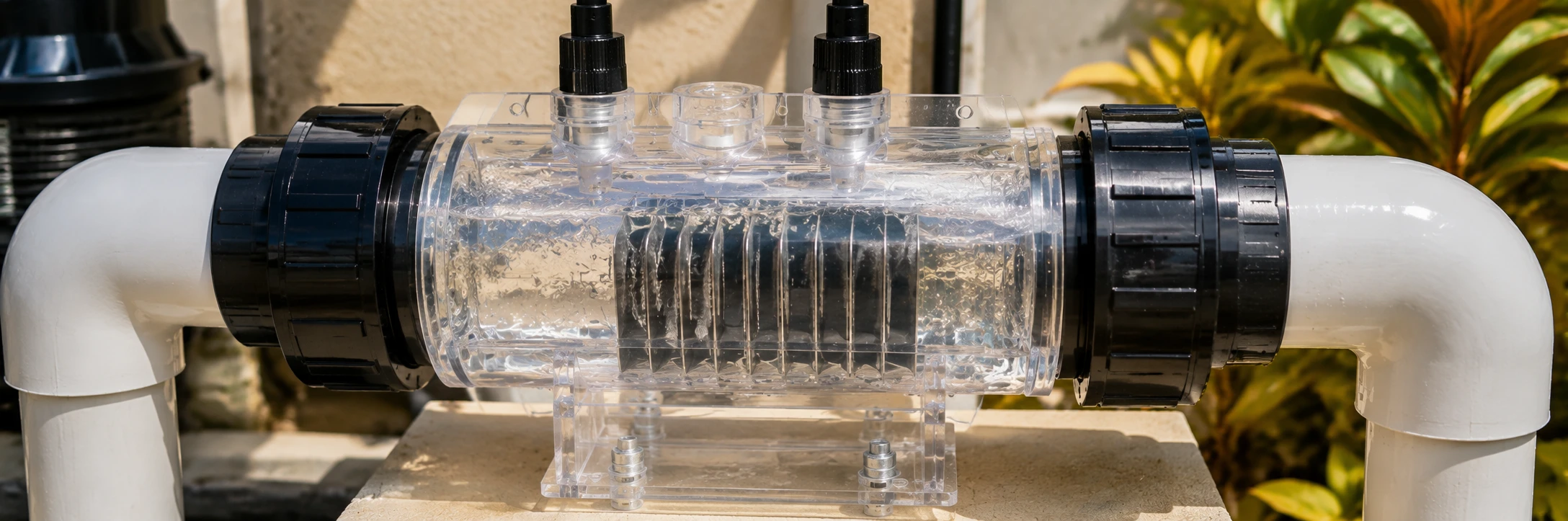
Installing an automatic salt water chlorinator for residential pool plumbing requires placing each piece of equipment in a precise sequence. Each component must perform its task in a specific order to protect the rest of your equipment pad from premature wear or damage.
The circulation line always begins at the pool intake points, drawing water through the main drains and surface skimmers. The pool pump provides suction to move this water forward into the filtration tank, where sand, cartridge, or DE media traps physical debris. After exiting the filter, the clean water flows through your gas heater, heat pump, or solar heating array. If your setup includes an automated acid feeder or chemical dosing pump to manage water balance, that injection point comes after the heating equipment.
The electrolytic salt cell must always be installed as the absolute last component on the return line before water flows back into the pool. Placing the salt cell after all heaters and pumps is vital because the cell generates a highly concentrated stream of sanitizer right at its outlet. If a salt cell were placed before a gas heater, that concentrated chlorine stream would pass directly through the heater’s internal copper heat exchanger, causing severe metallic corrosion and premature heater failure. Installing the cell downstream guarantees that concentrated chlorine is diluted immediately as it mixes into the main body of pool water.
Additionally, installing a physical mechanical flow switch directly ahead of the salt cell is an essential safety measure. The flow switch monitors physical water movement inside the PVC pipe. If your filter pump stops running or loses prime, the flow switch senses the loss of movement and cuts electrical power to the salt cell instantly. This prevents chlorine gas from building up inside closed PVC pipes, keeping your equipment pad safe.
When evaluating different residential salt generators on the market, several technical features stand out in terms of daily convenience, equipment longevity, and ease of use.
Mineral scale—primarily calcium carbonate—naturally deposits onto electrified titanium plates over time, particularly in areas with hard tap water. Modern residential chlorinators include self-cleaning technology that periodically reverses the direction of the electrical current across the plates. Reversing polarity causes thin layers of mineral crust to flake off automatically, flowing harmlessly into the pool water. This feature dramatically reduces how often you need to dismantle and manually clean the cell.
Mineral scale—primarily calcium carbonate—naturally deposits onto electrified titanium plates over time, particularly in areas with hard tap water. Modern residential chlorinators include self-cleaning technology that periodically reverses the direction of the electrical current across the plates. Reversing polarity causes thin layers of mineral crust to flake off automatically, flowing harmlessly into the pool water. This feature dramatically reduces how often you need to dismantle and manually clean the cell.
If you use an energy-efficient variable-speed pump that runs at low speeds for extended periods to save electricity, ensure the chlorinator cell can operate reliably under low flow rates. High-quality salt cells feature sensitive flow switches designed to register lower flow volumes without triggering false error codes or shutting down prematurely.
While an automated salt chlorine generator automates daily sanitizer production, maintaining balanced overall water chemistry remains essential. Salt water systems do not eliminate water testing; rather, they streamline the chemical balancing process.
| Water Chemistry Parameter | Recommended Target Range | Primary Purpose in Salt Pools |
|---|---|---|
| Salinity | 3,000 – 4,000 ppm | Powers active chlorine generation. |
| Free Available Chlorine | 1.0 – 3.0 ppm | Sanitizes water and destroys bacteria. |
| pH Level | 7.2 – 7.6 | Prevents eye irritation and equipment corrosion. |
| Total Alkalinity | 80 – 120 ppm | Stabilizes pH balance against rapid swings. |
| Cyanuric Acid (CYA) | 30 – 50 ppm | Protects free chlorine from sunlight breakdown. |
| Calcium Hardness | 200 – 400 ppm | Protects pool plaster and prevents cell scaling. |
One natural operational characteristic of a salt chlorine generator is a tendency for the water’s pH level to drift upward over time. As the electrolytic cell converts salt into chlorine, it generates a small amount of sodium hydroxide as a byproduct, which slowly raises the pH of the pool water.
If your pH drifts above 7.8, the active chlorine in your pool becomes significantly less effective at destroying bacteria, and calcium scale can begin forming on your pool plaster and inside the salt cell. To manage pH drift, test your water weekly and add small, measured doses of liquid muriatic acid or dry acid as needed to keep your pH centered between 7.2 and 7.6.
Cyanuric acid acts as a sunblock for the chlorine in your pool. Unshielded chlorine is destroyed rapidly by sunlight; UV rays can break down up to 90% of free chlorine in an outdoor pool in just two hours. Maintaining cyanuric acid levels between 30 and 50 parts per million ensures the chlorine generated by your salt cell remains active in the water long enough to perform its sanitizing job, reducing the workload on your equipment.
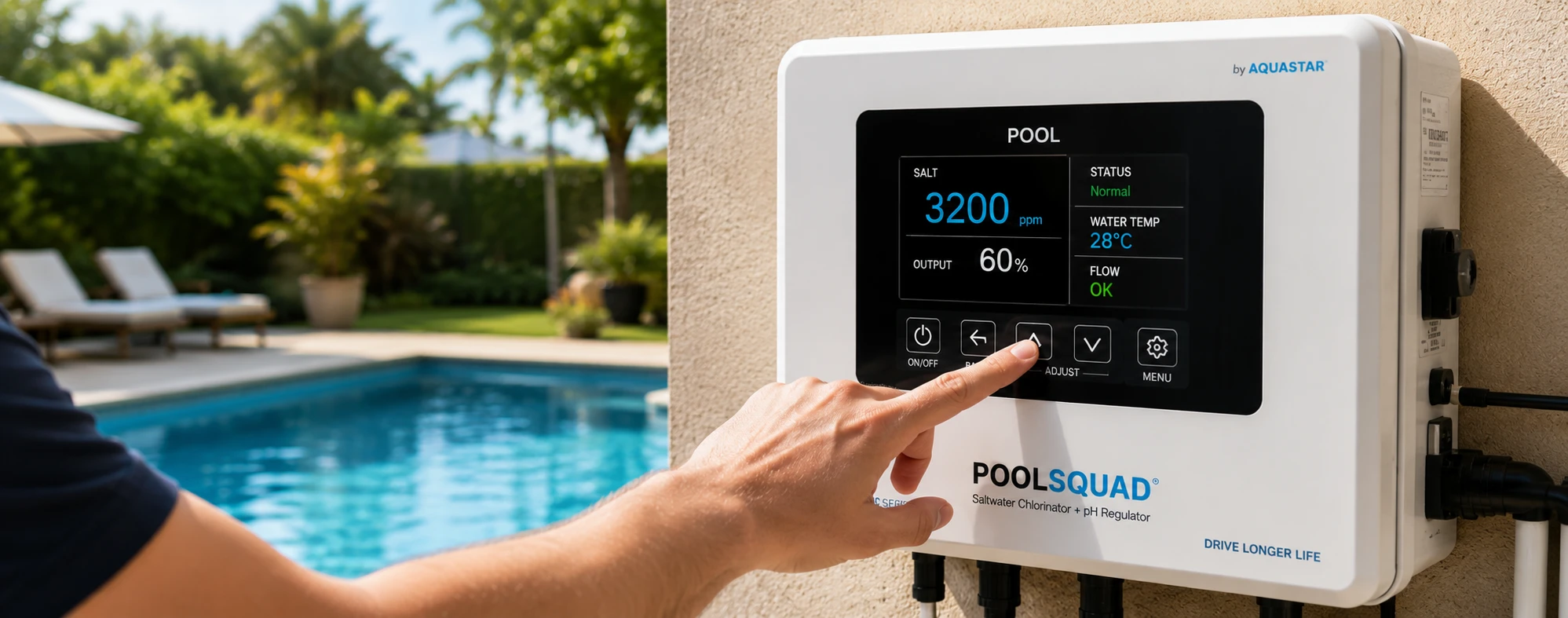
Adding salt to a home swimming pool is a simple task, but following the correct procedure protects your equipment from unnecessary stress.
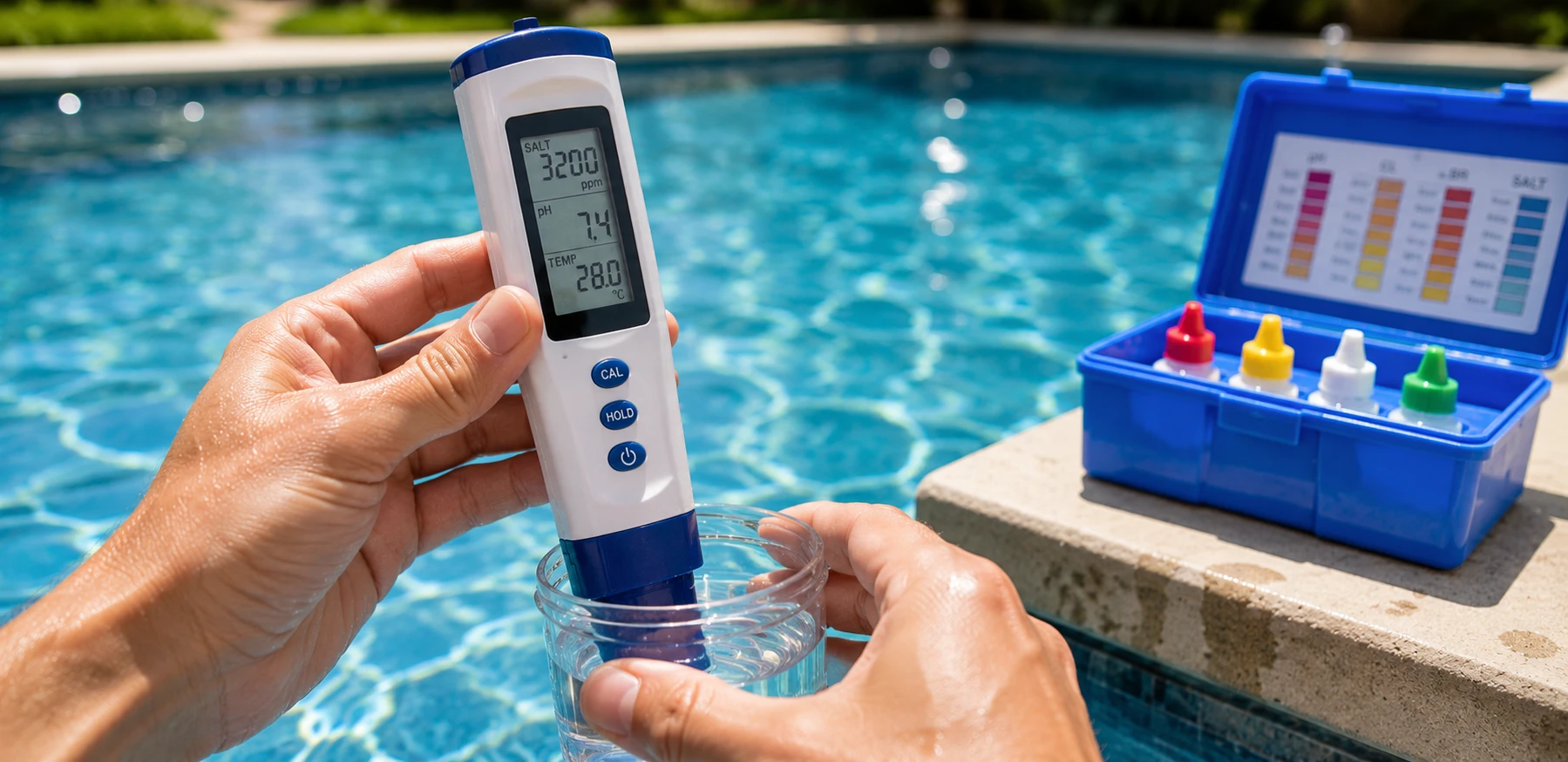
Test Baseline Salinity: Test your water’s baseline salinity level using a digital salt meter or salinity test strips. Tap water and existing pool water often contain several hundred parts per million of natural minerals, so knowing your starting point prevents over-salting.
Calculate Salt Requirement: Calculate how many 40-pound bags of salt you need to reach your target concentration, typically around 3,500 parts per million.
Select High-Purity Salt: Purchase pure, non-iodized pool salt with a purity rating of 99.5% or higher. Avoid using rock salt or salt containing anti-caking additives, as these additives can stain your pool surface.
Power Off the Salt Generator: Turn off electrical power to the salt chlorinator controller before adding salt, while keeping your main pool filter pump running continuously.
Broadcast Salt Around Pool: Walk around the perimeter of the pool and broadcast the salt evenly into the deep end, staying away from skimmer openings.
Brush Until Fully Dissolved: Use a pool brush to push undissolved salt around until it dissolves completely into the water. Never dump bags of salt directly into the skimmer box or main drain, as concentrated salt passing directly through the pump and filter can damage mechanical seals and internal components.
Circulate Water for 24 Hours: Allow your filter pump to run continuously for 24 hours after brushing the salt into the water. This extended pump run time distributes the salt evenly throughout the entire volume of pool water.
Power On the System: Once the 24-hour mixing period finishes, turn the salt chlorinator controller back on and set your desired chlorine output percentage.
An automatic salt water chlorinator for residential pool systems dramatically reduces everyday chores, but a few quick seasonal inspections will help keep your investment operating smoothly for its entire expected service life of 4 to 7 years.
Every month, visually inspect the transparent housing of your salt cell. Look between the titanium plates for any crusty, chalky white deposits. If the plates appear clean and dark, the self-cleaning reverse polarity feature is working effectively, and no manual cleaning is necessary. If you notice heavy white scale bridging the gaps between plates, it is time to perform a mild acid wash.
To clean a scaled salt cell safely, follow these step-by-step instructions:
Safety Preparation: Put on protective safety goggles and rubber gloves. Always perform chemical maintenance outdoors in a well-ventilated area.
Power Down and Isolate: Turn off the circuit breaker supplying power to your pool equipment pad. Close the plumbing isolation valves and unscrew the threaded unions on both sides of the cell to remove it from the plumbing line.
Mix the Cleaning Solution: In a clean plastic bucket, pour four parts fresh water first, then carefully add one part muriatic acid. Always add acid into water—never pour water into acid, as adding water to acid can cause dangerous chemical splashing.
Soak the Internal Plates: Attach a cell cleaning cap or stand to one end of the cell to seal it. Stand the cell upright and fill the interior with the diluted acid solution until the titanium plates are submerged. Allow the solution to soak for 10 to 15 minutes while the acid breaks down the calcium scale.
Rinse and Reinstall: Once the bubbling subsides and the scale dissolves, pour the solution into an approved disposal container. Rinse the interior of the cell thoroughly with a garden hose, reattach the cell to your plumbing line, and restore power.
Never scrape the internal plates with screwdrivers, metal putty knives, or wire brushes. The titanium plates are covered with a delicate micro-thin ruthenium coating that enables electrolysis. Scraping the plates strips off this coating, permanently damaging the cell.
Avoiding a few common operational missteps will ensure your salt chlorination system delivers reliable performance season after season:
Neglecting Sacrificial Anodes: Salt water increases electrical conductivity, which can accelerate galvanic corrosion on exposed metals like stainless steel pool ladders, light rims, and copper heater parts. Installing a zinc sacrificial anode on your equipment pad protects metal fixtures by attracting galvanic current away from high-value equipment.
Ignoring Salt Cell Sizing: Installing an undersized cell to save money up front leads to higher electricity bills and premature cell failure, as the unit must run constantly at 100% capacity to sanitize the pool.
Allowing Calcium Hardness to Spike: High calcium levels in your source water speed up scale formation inside the cell housing. Keeping your calcium hardness levels between 200 and 400 parts per million helps prevent rapid scaling.
Forgetting to Adjust Output Seasonally: Chlorine demand changes significantly with water temperature. Running your cell at high output during cool spring or autumn months wastes energy and creates excess chlorine. Lower your output percentage as water temperatures drop, and increase it as summer heat arrives.
Upgrading your pool care routine with an automatic salt water chlorinator for residential pool sanitization transforms backyard pool ownership. By shifting from manual chemical additions to automated, on-demand sanitization, you eliminate sudden chemical spikes, prevent chloramine buildup, and protect your family from handling dangerous chemical containers.
When you size your cell properly using the 1.5x rule, maintain proper cyanuric acid and pH levels, and perform gentle visual inspections, your automated salt chlorinator will reliably deliver clear, soft, and inviting water season after season. Investing in automated salt chlorination allows you to spend less time working on your pool equipment pad and more time enjoying your swimming pool with family and friends.
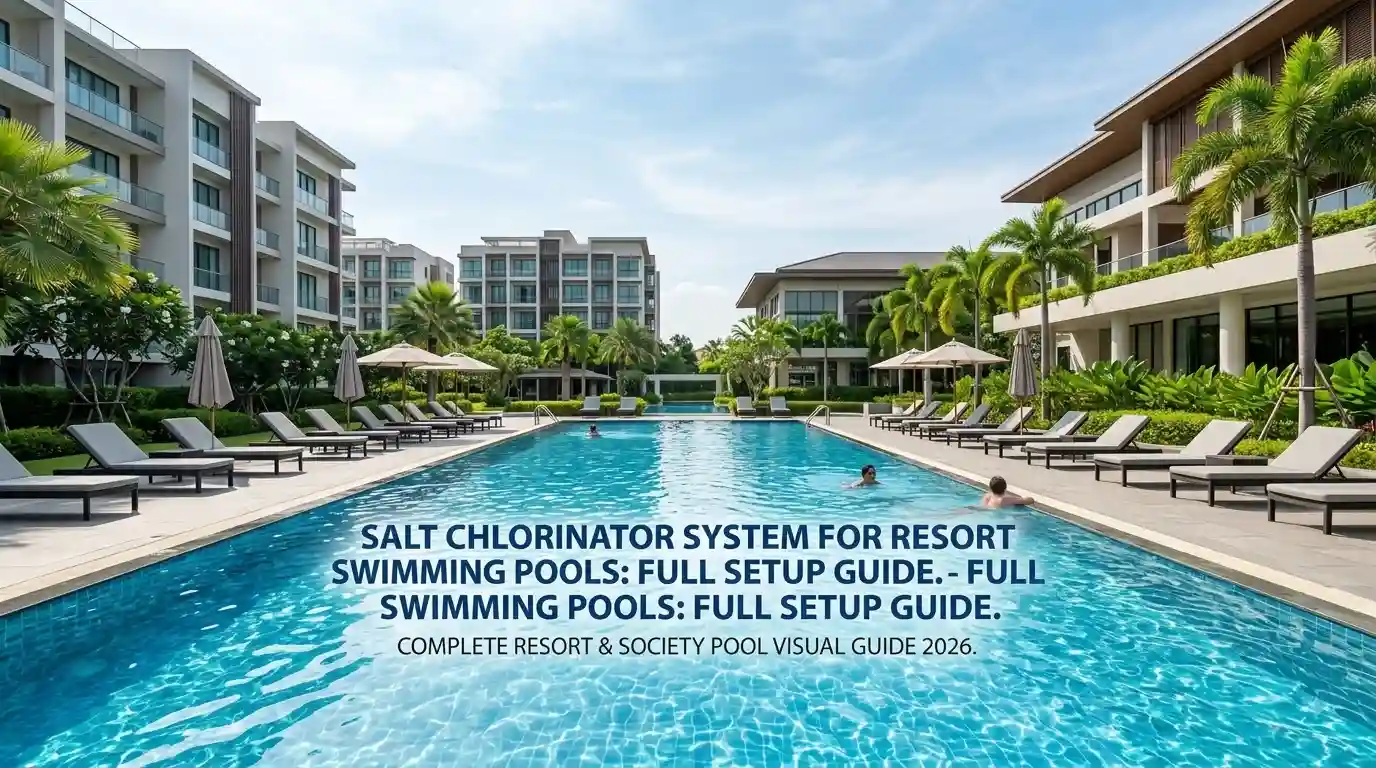
Maintaining a commercial swimming pool—whether in a high-end luxury resort or a busy residential housing society—is a continuous balancing act. If you manage a facility or sit on an apartment committee, you already know the drill: daily complaints about harsh chemical smells, burning red eyes, dry skin, and faded swimwear.
On top of guest complaints, manually buying, storing, and pouring gallons of liquid chlorine or calcium hypochlorite is both a safety hazard and a massive recurring operational expense.
This is precisely why modern property managers are upgrading to an automated salt chlorinator system for resort swimming pools and large housing complexes. By converting simple, natural salt into clean, continuous chlorine right inside your plumbing lines, you eliminate chemical spikes and create an inviting, spa-like experience.
In this comprehensive setup guide, we will unpack how commercial salt chlorination works, how to properly size and install your equipment, and how to maintain crystal-clear water with minimal effort.
At its core, a salt chlorine generator is an inline water sanitation unit that produces pure chlorine on-site through a process known as electrolysis.
Instead of adding dangerous chemical chlorine directly into the water, pool operators dissolve pure pool-grade salt (sodium chloride) into the pool. As the mildly salty water recirculates through your filtration room, it passes through an electrolytic cell filled with titanium plates. A safe, low-voltage electric current passes between these plates, instantly converting the dissolved salt into hypochlorous acid—the exact active sanitizing agent found in traditional chlorine.
Once the active chlorine sanitizes the water and kills off bacteria, algae, and organic debris, it turns right back into salt. It is a self-regenerating, closed-loop cycle.
Transitioning to an automated commercial pool salt system is not just about adopting new technology—it is about fundamentally improving guest satisfaction and operational safety.
The traditional “chlorine smell” isn’t actually caused by chlorine; it is caused by chloramines, which form when chlorine combines with sweat, oils, and organic waste. As water passes through the electrolytic cell, the intense energy destroys these chloramines. The result? Odor-free, silky-soft water that won’t sting eyes or dry out sensitive skin.
Storing hundreds of liters of liquid bleach or bags of chlorine powder requires dedicated, ventilated fire-safe storage units. Handling these products poses serious chemical burn risks to staff. Food-grade pool salt, on the other hand, is completely non-hazardous, safe to handle, and easy to store.
Manual chlorine dosing creates extreme peaks and valleys. Pools are over-chlorinated in the morning, making swimming uncomfortable, but by peak afternoon heat and heavy swimmer load, the chlorine gets burned off, leaving the water vulnerable to algae. A salt chlorinator works continuously while the filter pump runs, keeping chlorine levels perfectly flat and reliable.
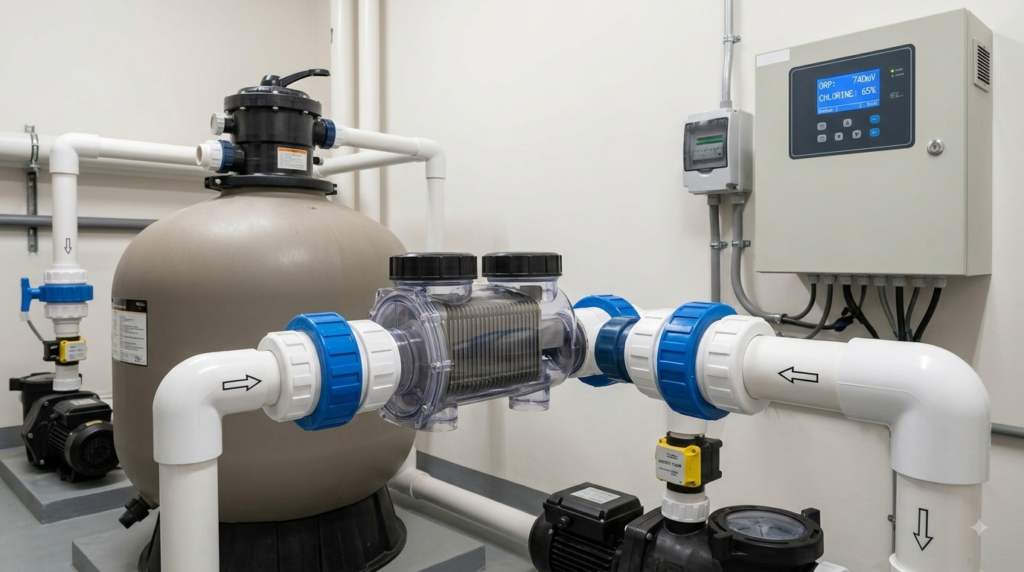
Under-sizing your chlorination system is one of the most common mistakes facility operators make. If the cell is too small, it may run at 100% capacity continuously, which can shorten its lifespan and make it difficult to maintain proper chlorine levels during busy summer weekends.
Total Water Volume: Measured in cubic meters (m³) or liters.
Bather Load: High turnover in resort pools or weekend peak hours in apartment complexes.
Sunlight & UV Exposure: Direct sunlight rapidly breaks down free chlorine.
Water Temperature: Warm climates accelerate algae growth and chlorine consumption.
For warm, heavily used commercial pools, aim for 1.5 to 2.0 grams of chlorine output per hour for every 1,000 liters (1 m³) of water.
Housing Society Pool Volume: 200 m³(200,000 Litres)
Required Production: 200 m³ x 1.5 g/h = 300 g/h minimun Capacity
Setup Strategy: Install either a dedicated 300 g/h} commercial power generator module or two 150 g/ cells in a dual-manifold layout for built-in redundancy.
Proper installation in your plant room guarantees efficient performance and protects your pool equipment from premature wear.
The cell must be the final piece of equipment on the return line before water goes back into the pool. Never place a salt cell before heaters or pumps, as concentrated chlorine will corrode sensitive heat exchangers and impellers.
Never hard-pipe a commercial cell directly into your main line without a bypass manifold. Installing isolation valves allows maintenance personnel to clean or service the cell without taking the entire filtration system offline.
The control box must be electrically wired to the main pump contactor or Variable Frequency Drive (VFD). If the filtration pump stops operating, the chlorinator must lose power instantly to avoid gas accumulation inside the plumbing.
Commercial pools feature stainless steel ladders, light rims, and metal fittings. Installing a sacrificial zinc anode on the return line prevents stray electrical currents and salt water from causing galvanic corrosion on metal pool fixtures.
Maintaining balanced parameters is essential for effective shared pool water treatment. Salt water isn’t maintenance-free; it simply changes how you maintain the water chemistry.
| Parameter | Ideal Target Range | Why It Matters |
|---|---|---|
| Salinity | 3,500 – 4,500 ppm | Required for the electrolytic cell to split salt effectively. |
| Free Chlorine | 2.0 – 4.0 ppm | Destroys pathogens and keeps water safe for bathers. |
| pH Level | 7.2 – 7.6 | Keeps chlorine active and prevents skin irritation. |
| Total Alkalinity | 80 – 120 ppm | Acts as a buffer to keep your pH stable. |
| Cyanuric Acid (CYA) | 30 – 50 ppm | Protects free chlorine from being destroyed by UV sunlight. |
| Calcium Hardness | 200 – 400 ppm | Prevents plaster erosion and scale formation on cell plates. |
As electrolysis occurs, a mild byproduct called sodium hydroxide is released, which slowly causes the water pH to rise. If the pH rises above 7.8, chlorine can lose more than 50% of its sanitizing effectiveness.
To keep your housing society pool chlorinator running at peak efficiency, pair it with an inline pH controller. A probe continuously reads water acidity and automatically triggers a small peristaltic pump to inject diluted acid whenever pH drifts too high.
Instead of running your cell at a fixed percentage, commercial systems rely on Oxidation-Reduction Potential (ORP) sensors. ORP measures the actual sanitizing power of the water in millivolts (mV). When many guests enter the pool at once, the ORP reading drops, instantly telling the chlorinator to increase chlorine production until the target level of 720–750 mV is restored.
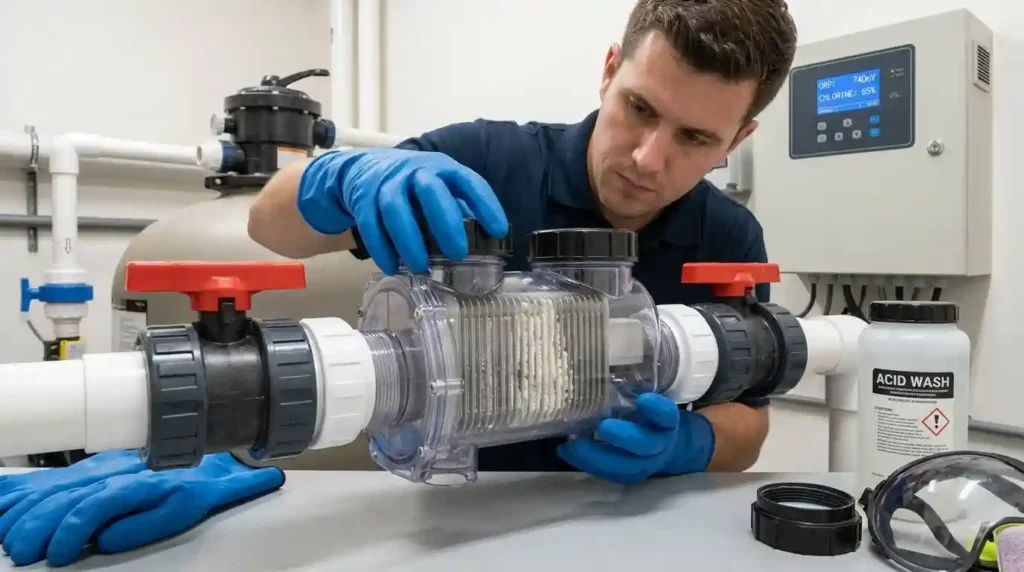
To ensure your titanium plates last their full 4 to 6-year operational life, set up a simple maintenance schedule.
Visual Scaling Check: Inspect the clear cell housing for white calcium deposits on the titanium plates.
Flow Switch Testing: Shut down the main filter pump to confirm that the flow switch cuts power to the controller automatically.
Salinity Check: Test salinity using a digital meter or titration strips, adding salt if backwashing or heavy rain diluted the water.
If calcium scale builds up inside the cell, clean it using a mild acid solution:
Wear protective eyewear, rubber gloves, and work in a well-ventilated space.
Isolate the cell using your 3-valve bypass loop, disconnect the power cable, and unscrew the plumbing unions.
Mix 1 part Hydrochloric (Muriatic) Acid into 4 parts fresh water inside a clean plastic bucket. Always pour acid into water, never water into acid!
Soak the cell plates in the solution for 10 to 15 minutes until the bubbling stops. Rinse thoroughly with fresh tap water and reinstall. Never scrape titanium plates with metal tools, as this strips off the precious metal coating.
Upgrading your sanitation infrastructure to a reliable salt chlorinator system transforms pool management from a daily hassle into a hands-off, cost-effective process—giving residents and resort guests the crystal-clear water they expect.
YouTube is one of the most influential platforms in modern media, but its origin story is surprisingly simple: a small team wanted an easier way to share video online. In the early 2000s, uploading and sending video files was slow, formats were inconsistent, and most websites weren’t built for smooth playback. YouTube’s founders focused on removing those barriers—making video sharing as easy as sending a link.
YouTube was founded by three former PayPal employees: Chad Hurley, Steve Chen, and Jawed Karim. They combined product thinking, engineering skills, and a clear user goal: create a website where anyone could upload a video and watch it instantly in a browser.
At the time, sharing video often meant emailing huge files or dealing with complicated players and downloads. YouTube made video:
YouTube launched publicly in 2005. One of the most famous early moments was the first uploaded video, “Me at the zoo,” featuring co-founder Jawed Karim. The clip was short and casual—exactly the kind of everyday content that proved the platform’s big idea: ordinary people could publish video without needing a studio.
| 2005 | YouTube is founded and launches | Introduced easy browser-based video sharing |
| 2005 | “Me at the zoo” is uploaded | Became a symbol of user-generated video culture |
| 2006 | Google acquires YouTube | Provided resources to scale hosting and global reach |
By 2006, YouTube’s traffic was exploding. Video hosting is expensive—bandwidth and storage costs rise fast when millions of people watch content daily. Google’s acquisition gave YouTube the infrastructure and advertising ecosystem to grow into a sustainable business.
YouTube didn’t just create a popular website; it reshaped how people learn, entertain themselves, and build careers online. Its founding helped accelerate:
From a small startup idea to a global video powerhouse, YouTube’s founding is a classic example of a simple product solving a real problem—and changing the internet in the process.
Read More